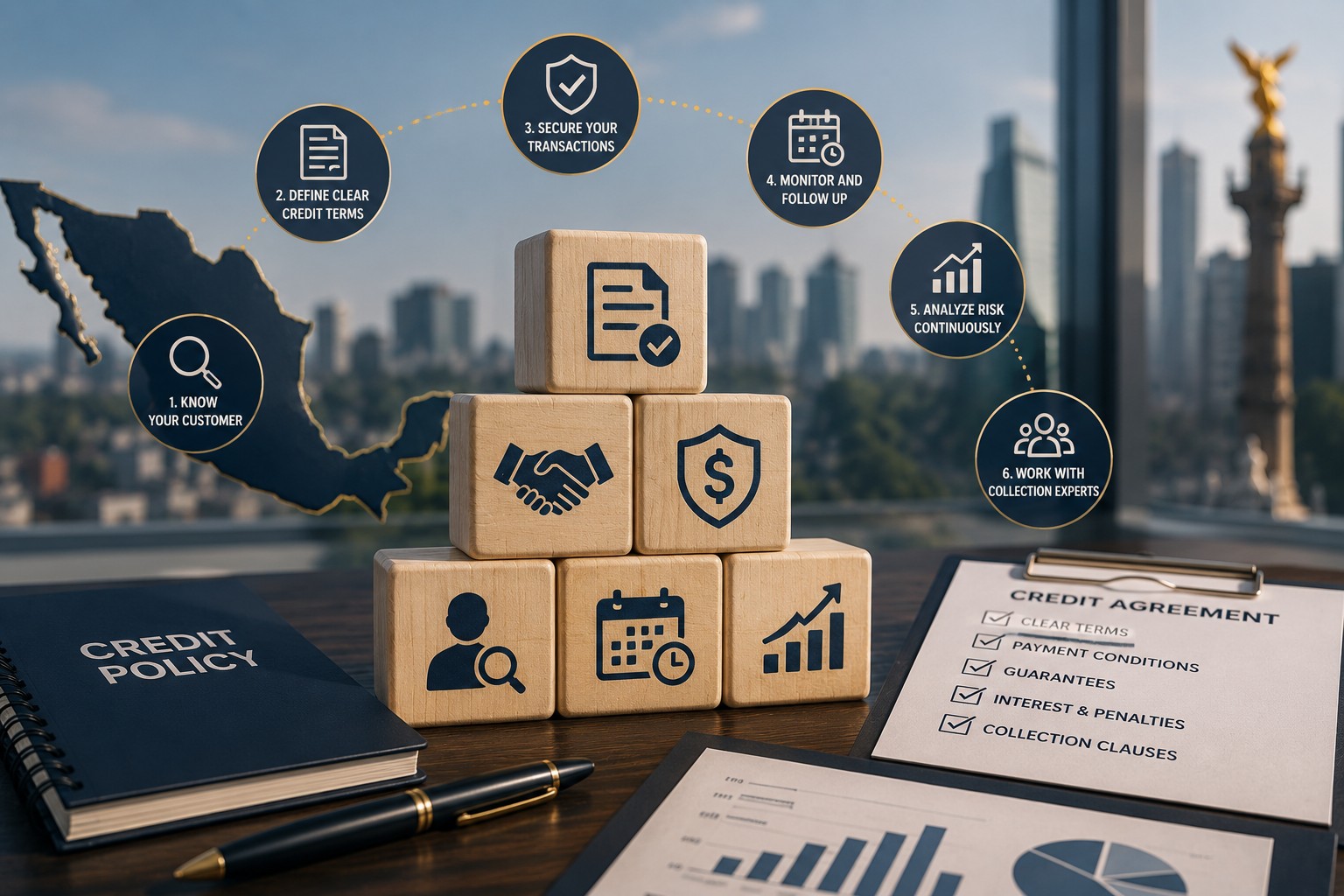
📋 Effective debt collection in Mexico begins before the first invoice is issued. Every credit sale carries a collection risk — and the companies that consistently recover the highest proportion of their B2B receivables are those that structured the credit relationship correctly from the outset. This article delivers six essential tips for credit operations in Mexico that reduce default risk, improve documentation quality, and position the creditor for fast, efficient recovery when accounts go overdue.
Are your credit operations in Mexico structured to minimize default risk?
Why Credit Operations Determine Debt Collection in Mexico Outcomes
The most common mistake in debt collection in Mexico is treating collection as a separate function from credit. It is not. Every collection outcome — fast recovery, slow recovery, write-off — is directly traceable to a decision made at the moment of credit approval: how much information was gathered, what documentation was signed, what credit limit was set, and whether the collection process was defined before it was needed.
The six tips below address precisely these decisions. They are not theoretical best practices — they are the structural differences that consistently separate companies with healthy receivable portfolios from those with chronic bad debt problems in the Mexican B2B market.
🔴 High risk
No KYC, no documentation, no follow-up process
Credit granted on intuition. Invoice only. No collection threshold defined. Recovery depends entirely on debtor goodwill.
🟠 Medium risk
Partial documentation, informal credit policy
Some credit checks, but no pagaré. Collection follows up informally. Escalation path exists but is not defined in writing.
🟢 Low risk
Full KYC, pagaré, defined collection process
Credit decision is data-driven. Every credit is documented with an executable instrument. Collection escalation is defined and triggered automatically.
As we explore in our guide on collection strategies in Mexico for B2B credit sales, the structural decisions made at credit approval are the highest-leverage intervention in the entire credit-to-cash cycle — far more valuable than any recovery tactic applied after default.
6 Essential Tips for Debt Collection in Mexico: From Credit Approval to Recovery
1
Develop clear, written credit policies — and enforce them consistentlyA credit policy is only valuable if it is written, distributed, and applied uniformly. For debt collection in Mexico, the credit policy defines: which buyers qualify for credit and at what limits, what documentation is required before the first invoice, what payment terms are standard and which require exception approval, and what triggers the escalation to formal collection. Companies that apply credit policies inconsistently — making exceptions based on relationship pressure or urgency — systematically create the conditions for the next bad debt. Consistency is not rigidity; it is the discipline that protects cash flow.
2
Base every credit decision on verified external information — not just the buyer's own representationsA buyer's self-reported financial position, payment history, and credit references are always positive. Effective B2B credit operations Mexico require independent verification. A KYC report on the buyer provides: RFC and SAT compliance status, D&B credit score in the Mexican market, national litigation search, address verification, and payment behavior references from third parties. As we detail in our article on KYC reports for B2B credit decisions in Mexico, the cost of a KYC is a fraction of one uncollectable invoice — and it transforms a gut-feel decision into a defensible one.
3
Set credit limits calibrated to verified payment capacity — not to order sizeA buyer requesting 2,000,000 MXN in credit who has a D&B score reflecting difficulty with obligations over 500,000 MXN is a candidate for a limited credit line — not a full approval. Credit limits should reflect the buyer's verified ability to pay at maturity, updated at least annually for recurring clients and reviewed immediately when payment warning signs appear. The most common structural error in Mexican B2B credit is calibrating credit limits to the size of the order rather than the verified capacity of the buyer to pay it.
4
Request commercial references — and actually verify themA buyer's commercial references are an underutilized intelligence source. Requesting references is standard; actually contacting them and asking specific questions about payment behavior, dispute history, and credit terms is uncommon — and therefore highly differentiating. Ask referees: what credit limit did you extend, what was the typical payment pattern, did the buyer ever default or dispute invoices without basis, and would you extend credit again today. The answers to these four questions consistently provide more actionable information than a credit score alone for assessing B2B debtor risk Mexico.
5
Formalize every credit with an executable instrument — not just an invoiceAn invoice is not a collection instrument. Under Article 1391 of the Código de Comercio, only specific instruments qualify as executable titles — meaning they allow immediate asset seizure through the juicio ejecutivo mercantil without requiring a separate trial on the merits. For effective debt collection in Mexico, every significant credit sale should generate a signed promissory note (pagaré) at the point of delivery. The pagaré transforms a credit claim into a judicially enforceable instrument from day one — and its 3-year prescription deadline must be tracked systematically from the maturity date.
6
Define and implement a structured collection process before the first invoice goes overdueA collection process defined reactively — after an account is already 90 days overdue — is too late. The collection escalation path should be designed as part of the credit policy: when does a payment reminder go out, when does a formal demand letter (carta de cobranza) get issued, when is a specialist engaged, and when does the prescription deadline on the pagaré trigger immediate judicial action. Companies that define these thresholds in advance consistently achieve better recovery rates than those that make escalation decisions informally under time pressure.
Are your credit operations in Mexico missing one of these six elements?
Debt Collection in Mexico: Defining the Escalation Process Before You Need It
Tip 6 above deserves specific expansion, because the absence of a defined collection escalation process is the single most common structural failure in Mexican B2B credit management. The escalation path for debt collection in Mexico should define five clear stages:
1
Day 1 of delay — documented internal contact. A phone call or email that is documented in the account file. This establishes the start of the formal collection record and gives the debtor an opportunity to communicate a legitimate issue before formal escalation begins.
2
Day 15–30 — formal demand letter (carta de cobranza). A professionally drafted letter documenting the amount owed, the due date, and the consequences of non-payment. This signals a transition from informal to structured collection and establishes the legal record that supports all subsequent actions.
3
Day 30–60 — specialist engagement and payment agreement. As we detail in our article on alternatives for recovering overdue accounts receivable in Mexico, a specialist engaged within this window resolves 70–80% of B2B accounts without litigation. If a payment agreement is reached, it must be formalized as a pagaré — not a verbal commitment.
4
Day 60–90 — escalation review and judicial preparation. If extrajudicial efforts have not produced a signed agreement, prepare the judicial file: confirm the pagaré is intact, verify the prescription deadline, locate debtor assets, and evaluate whether juicio ejecutivo mercantil proceedings should be initiated immediately or after one final extrajudicial contact.
5
Before prescription deadline — judicial filing. If the account remains unresolved and the prescription deadline on the pagaré is within 180 days, initiate judicial proceedings immediately regardless of extrajudicial status. The prescription deadline is not a warning — it is an expiry. Once it passes, the judicial option is permanently and irrecoverably lost.
⚠️ Most common failure in debt collection in Mexico: Companies extend informal payment deadlines repeatedly — "give the client one more chance" — until the prescription deadline on the pagaré has narrowed to the point where judicial action is urgent rather than strategic. Define the escalation threshold in advance and enforce it. The debtor's discomfort at being escalated is not a reason to delay; it is evidence that the escalation is working.
Frequently Asked Questions — Debt Collection in Mexico
What are the most important tips for effective debt collection in Mexico?
The six most impactful practices for debt collection in Mexico are: (1) maintain written credit policies applied consistently; (2) base credit decisions on verified external information, including a KYC report; (3) calibrate credit limits to verified payment capacity; (4) actually verify commercial references by asking structured questions; (5) formalize every significant credit with a pagaré or credit contract rather than relying on an invoice alone; and (6) define the collection escalation process in writing before the first invoice goes overdue. These six practices consistently separate companies with healthy receivable portfolios from those with chronic bad debt problems in the Mexican B2B market.
Why is a promissory note (pagaré) important for debt collection in Mexico?
A pagaré is an executable title under Article 1391 of the Código de Comercio — meaning it allows a creditor to initiate juicio ejecutivo mercantil proceedings immediately upon default, requesting asset seizure from the first day of proceedings without requiring a separate trial on the merits of the debt. For debt collection in Mexico, this is the difference between a credit claim that requires 12–18 months of litigation to reach enforcement and one that can produce asset seizure within days of default. The pagaré also has a prescription deadline of 3 years from its maturity date — after which the judicial option is permanently lost.
When should a company engage a specialist for debt collection in Mexico?
The optimal engagement window is 30 to 45 days after the invoice due date — when the account shows payment warning signs but has not yet aged past the point where recovery rates begin declining significantly. A B2B collection specialist engaged at this stage achieves materially better outcomes than one engaged at 90 or 180 days overdue, because the debtor's liquidity, willingness to negotiate, and asset visibility are all higher. Engaging a specialist should not be a last resort — it should be a defined step in the collection escalation process, triggered automatically when the 30–45 day threshold is reached without a satisfactory response from the debtor.
How does a KYC report improve debt collection outcomes in Mexico?
A KYC report improves debt collection in Mexico outcomes in two ways: before credit is extended, it provides the intelligence needed to make a defensible credit decision — setting the right credit limit, requiring stricter documentation for high-risk buyers, or declining credit entirely for buyers with active litigation or SAT irregularities. After an account goes into active collection, the KYC provides the information a specialist needs to locate the debtor, identify assets available for judicial enforcement, and assess the viability of continued recovery effort. A company that runs KYC before credit approval is better positioned at every stage of the collection cycle.
Structure your credit operations for effective debt collection — before the next invoice goes overdue.