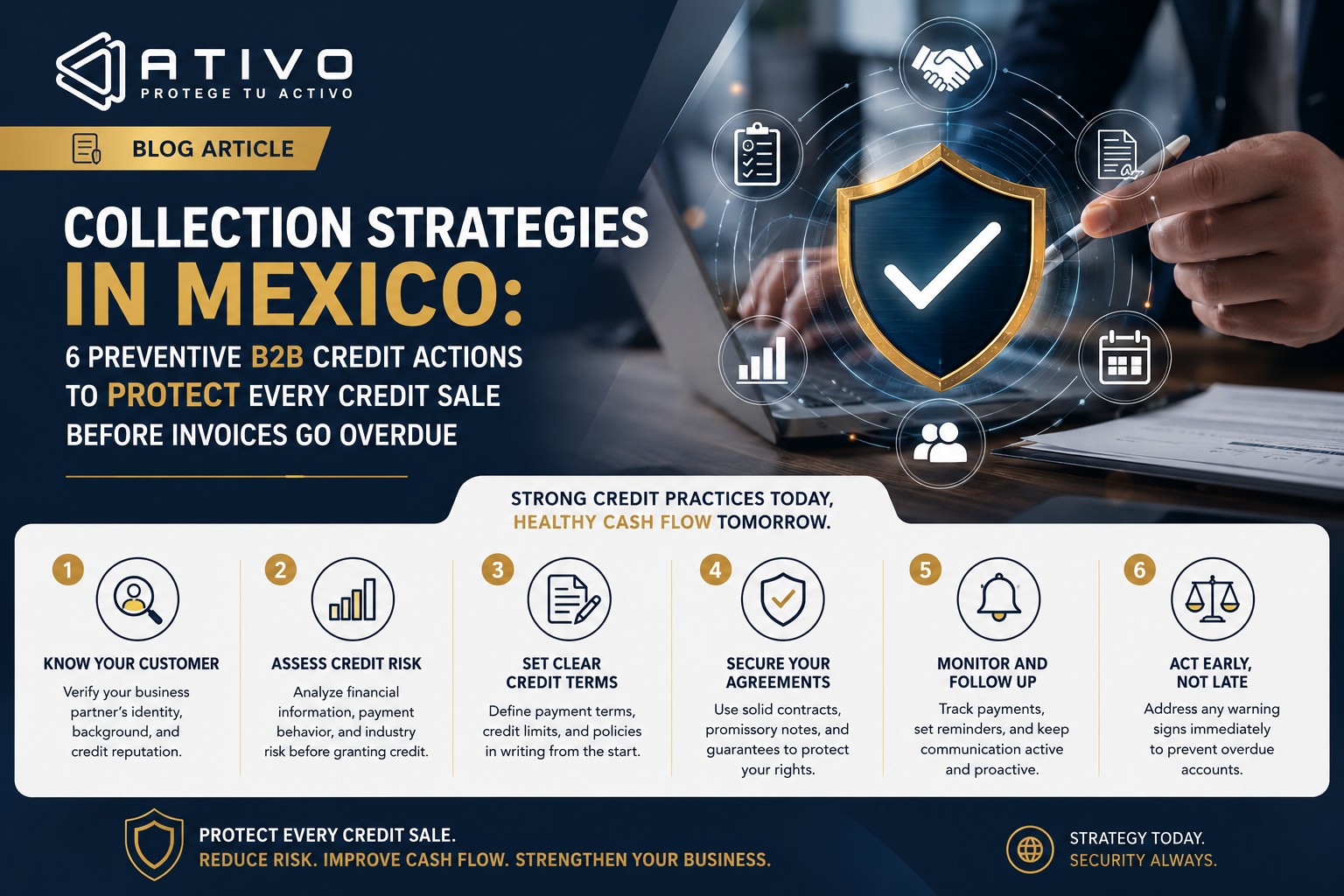

🎯 The most effective collection strategies in Mexico are not reactive — they are built into the credit process before the first invoice is issued. Companies that consistently recover the highest proportion of their B2B receivables in Mexico are not those with the most aggressive collection teams; they are those that made better credit decisions, demanded better documentation, and established clearer payment structures at the moment of the sale. This article details six preventive collection strategies in Mexico that reduce bad debt before it materializes — and what to do when prevention is not enough.
Are your credit sales in Mexico protected with a structured preventive strategy?
→ Get a free credit and collection strategy assessment from ATIVOCollection Strategies in Mexico: Why Preventive Always Outperforms Reactive
Most discussions of collection strategies in Mexico focus on what to do after an invoice goes overdue. The higher-value conversation is what to do before the invoice is issued — because the structural decisions made at the point of credit approval determine whether a receivable is manageable or unrecoverable when it deteriorates.
- KYC on the buyer before the first invoice
- Credit limit calibrated to debtor capacity
- Pagaré or contract signed before delivery
- Clear penalty interest clause in writing
- Structured follow-up from day 1 of delay
- Prescription deadlines tracked systematically
- No credit assessment before extending credit
- Credit limits based on gut feel, not data
- Invoice only — no executable instrument
- Verbal agreement on payment terms
- Follow-up begins at 90+ days overdue
- Prescription deadline missed permanently
As we explore in our article on managing debts in Mexico before they silently affect your cash flow, the cost of one uncollectable invoice — direct write-off, collection effort, legal fees, and cash flow impact — consistently exceeds the cost of the preventive measures that would have avoided it.
The Credit Decision Scenario That Makes Collection Strategies in Mexico Essential
This scenario — which most B2B companies in Mexico have faced — illustrates the exact moment where credit collection strategies Mexico are either present or absent. A company with structured preventive strategies answers this question with a clear process: run a KYC, evaluate the debtor's capacity, set an appropriate credit limit, issue a pagaré for the deferred amount, and document the penalty interest clause. A company without these strategies answers it with intuition — and frequently absorbs the loss when the sixty-day payment does not arrive.
The six strategies below define what a structured preventive approach looks like in practice.
6 Preventive Collection Strategies in Mexico for B2B Credit Sales
Are your credit policies in Mexico missing one or more of these six elements?
→ Request a free credit policy review from ATIVOWhen Preventive Collection Strategies in Mexico Are Not Enough: The Escalation Path
Even the most comprehensive preventive collection strategies in Mexico do not eliminate all default risk — they reduce it and improve recovery outcomes when accounts do deteriorate. When a buyer who was properly vetted, properly documented, and properly managed still stops paying, the escalation path must be structured, rapid, and legally grounded.
Frequently Asked Questions — Collection Strategies in Mexico
What are the most effective collection strategies in Mexico for B2B credit sales?
The most effective collection strategies in Mexico are preventive: running a KYC report before extending credit, calibrating credit limits to verified payment capacity, formalizing every deferred payment with a pagaré or credit contract, documenting penalty interest in writing, verifying the buyer's stated use for the goods or services, and activating structured follow-up from day one of delay — not day 30 or day 90. Companies that implement all six consistently achieve lower bad debt provisions and better recovery outcomes than those that manage credit informally. When prevention is not enough, the escalation path should be defined before it is needed: specialist engagement at 30–60 days, judicial action before prescription deadlines expire.
What is the most important document for protecting a credit sale in Mexico?
The promissory note (pagaré) is the most powerful instrument within any collection strategy in Mexico. As an executable title under Article 1391 of the Código de Comercio, it allows the creditor to initiate juicio ejecutivo mercantil proceedings immediately upon default — requesting asset seizure from the first day without requiring a separate trial on the merits. No other credit document provides this level of immediate judicial enforceability. The pagaré should be signed at the point of delivery or transaction, not after the account goes overdue.
When should a company escalate from preventive to active collection in Mexico?
The escalation threshold should be defined before it is needed — ideally as a written credit policy, not a reactive decision. Standard triggers: formal demand letter at 15 days overdue for high-risk accounts, 30 days for standard accounts; specialist engagement at 30–45 days for any account showing unresponsiveness; judicial escalation preparation at 60–90 days if extrajudicial efforts have not produced a signed payment agreement. The worst outcome in collection strategies in Mexico is not escalating too early — it is waiting until the prescription deadline on the pagaré has narrowed to the point where judicial action becomes urgent instead of strategic.
How does a KYC report improve collection strategies in Mexico?
A KYC report transforms credit decisions from empirical to defensible — replacing gut-feel assessments with documented intelligence. For collection strategies in Mexico, the KYC provides the information needed to set the right credit limit (based on D&B score and payment behavior), identify risk factors that require stricter documentation (litigation history, SAT irregularities), and — if the account eventually requires judicial collection — locate the debtor's assets and verify they remain in the company's name. A KYC run at the point of credit approval is the highest-ROI investment in the collection cycle: it costs a fraction of one uncollectable invoice and improves outcomes across the entire credit relationship.
Build collection strategies into your credit process — before the next invoice goes overdue.
→ Get a free credit and collection strategy assessment from ATIVO