
⚠️ When a Mexican client becomes an insolvent debtor in Mexico, the creditor faces a decision that cannot wait: pursue recovery before assets disappear, or accept the loss and protect what remains of the commercial relationship. This article provides a structured framework for making that decision — early identification of insolvency signals, the legal options available under Mexican commercial law, the write-off vs. pursue decision matrix, and the preventive measures that reduce the probability of encountering an insolvent debtor in the first place.
Facing an insolvent debtor in Mexico? Act before assets are transferred.
→ Get a free case assessment from ATIVO — no upfront feesWhat Does It Mean When a Debtor in Mexico Is Insolvent?
In Mexican commercial practice, an insolvent debtor in Mexico is a company that has stopped meeting its payment obligations — not because of a temporary cash flow problem, but because its liabilities systematically exceed its ability to pay. This distinction matters for the creditor: a debtor with a temporary cash flow problem is a negotiation case; an insolvent debtor is a recovery and loss-minimization case.
Mexican commercial law provides a formal insolvency framework through the Ley de Concursos Mercantiles (LCM) — the country's primary bankruptcy statute. Under the LCM, a commercial debtor who cannot meet more than 35% of their obligations as they mature may file for, or be subject to, concurso mercantil (commercial restructuring). Once a concurso mercantil is declared, creditors' ability to initiate individual collection actions is suspended — making early intervention before a formal insolvency filing the highest-priority action for any creditor. The full statute is available at Cámara de Diputados — Ley de Concursos Mercantiles.
The critical implication: a creditor who acts before a formal insolvency proceeding has full access to extrajudicial negotiation, payment agreements, and judicial instruments including asset seizure. A creditor who waits until the concurso is declared loses the ability to pursue individual collection and must participate in the collective creditor process — where recovery rates are significantly lower.
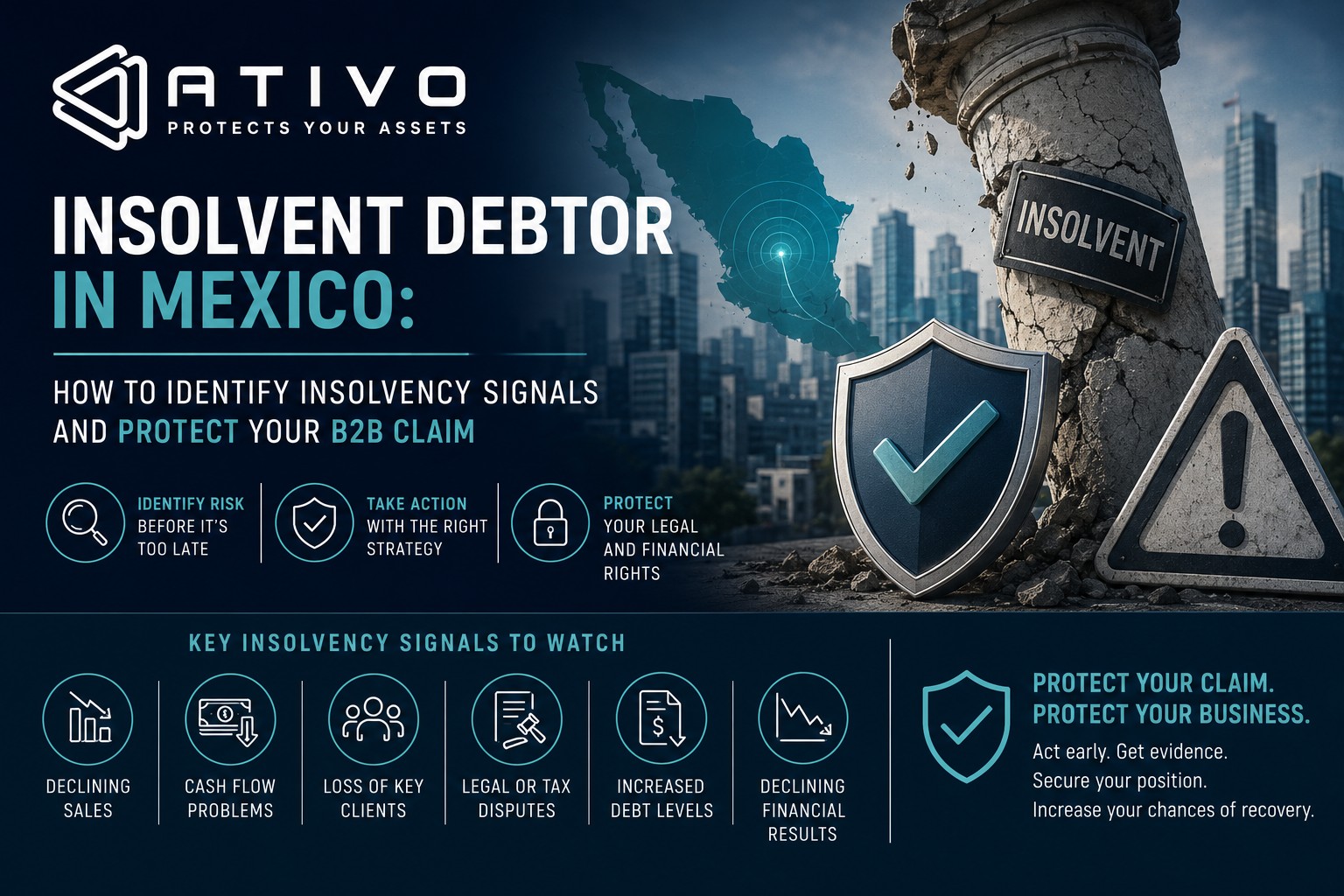
7 Early Warning Signs of an Insolvent Debtor in Mexico
The most effective intervention against an insolvent debtor in Mexico is early identification — before the formal insolvency proceeding is filed and before assets have been transferred. These seven signals consistently precede formal insolvency in the Mexican B2B market.

Are you seeing these signals in a Mexican client account right now?
→ Contact an ATIVO specialist before the situation deteriorates furtherInsolvent Debtor in Mexico: Pursue Recovery or Write Off? The Decision Matrix
Not every case involving an insolvent debtor in Mexico justifies continued active collection effort. The write-off vs. pursue decision should be based on four criteria — not on emotional reluctance to accept a loss or reflexive insistence on recovery regardless of cost.
- Prescription deadline is intact and not imminent
- Creditor holds a pagaré or executable title
- Debtor has identifiable assets (real estate, vehicles, bank accounts)
- Debt amount justifies collection and potential litigation cost
- No formal concurso mercantil has been filed yet
- Debtor is locatable and showing some responsiveness
- Prescription deadline has expired — judicial option permanently lost
- No documentation other than unsigned invoices exists
- Debtor has no identifiable assets or assets clearly transferred
- Concurso mercantil is declared — collective process applies
- Collection cost exceeds realistic recovery amount
- Debtor has ceased operations entirely
As we detail in our article on key strategies for bad debt recovery in Mexico, the write-off vs. pursue analysis should be conducted by a specialist who can evaluate the debt profile objectively — not by the internal team that extended the credit and has an emotional stake in the recovery outcome.
What to Do When You Identify an Insolvent Debtor in Mexico: 6 Structured Steps
As we detail in our guide on alternatives for recovering overdue accounts receivable in Mexico, the range of options available to a creditor facing an insolvent debtor depends entirely on the quality of the documentation held and the speed of the response. A creditor who acts in the first 30 days of insolvency signals has materially better options than one who acts at 180 days.
Frequently Asked Questions — Insolvent Debtor in Mexico
What is the difference between a debtor who is insolvent and one who is just late paying in Mexico?
A debtor who is late paying has a temporary cash flow issue — the obligation is acknowledged, the relationship is intact, and a structured payment agreement can produce full recovery. An insolvent debtor in Mexico has systematic liabilities that exceed their ability to pay — the obligation may be acknowledged, but the capacity to fulfill it is genuinely absent. The distinction matters because the response is different: a late payer requires a structured collection process; an insolvent debtor requires immediate asset identification, judicial action before transfers occur, and a formal pursue vs. write-off analysis.
What is a concurso mercantil in Mexico and how does it affect creditors?
A concurso mercantil is Mexico's primary insolvency proceeding under the Ley de Concursos Mercantiles. It is initiated when a commercial debtor cannot meet more than 35% of their obligations as they mature. Once declared by a court, all individual collection proceedings against the debtor are suspended — creditors must register their claims in a collective process overseen by a court-appointed administrator (síndico). Recovery rates in concurso mercantil proceedings are significantly lower than in direct collection, which is why creditors who identify debtor insolvency Mexico signals early and act before the formal filing achieve substantially better outcomes.
Can a creditor recover money from an insolvent debtor in Mexico before a concurso mercantil is filed?
Yes — and this is the highest-value window for creditors facing an insolvent debtor in Mexico. Before a formal insolvency filing, a creditor who holds an executable title (pagaré, qualifying contract) can initiate juicio ejecutivo mercantil proceedings and obtain an embargo preventivo (asset seizure) from the first day of proceedings. This legal action protects the creditor's claim against subsequent asset transfers and gives them priority in any negotiated resolution. The window between the first insolvency signal and the formal filing is where the most valuable intervention occurs.
How can a company prevent having an insolvent debtor in Mexico in its portfolio?
Prevention combines three practices: pre-credit KYC on every new buyer before extending credit (RFC status, D&B score, litigation history, payment behavior); systematic monitoring of the warning signs listed above for existing clients; and structured credit policies that require formal documentation — pagarés or credit contracts — for all significant credit sales. Companies that integrate all three consistently maintain lower bad debt provisions and achieve better recovery outcomes on the accounts that do go into distress. Early detection of debtor insolvency Mexico signals, combined with immediate professional intervention, is the most reliable way to minimize losses when insolvency occurs despite preventive measures.
Facing an insolvent debtor in Mexico? The window to protect your claim may be closing.
→ Get a free case assessment from ATIVO — act before assets are transferred