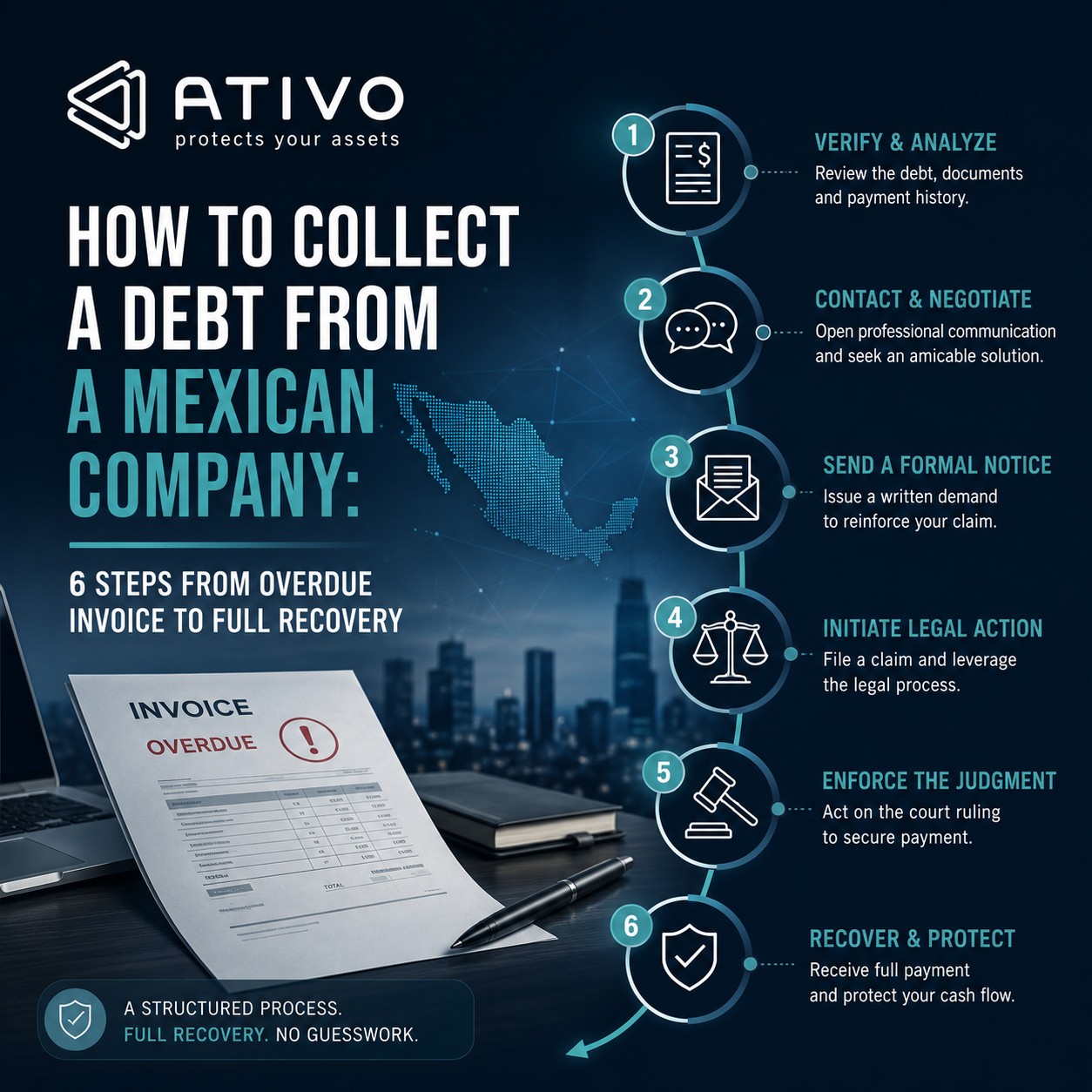

💡 The question is not whether the debt is recoverable — in most cases, it is. The question is whether you act strategically and early enough. This guide walks through the six steps to collect a debt from a Mexican company, including when to consider a law firm Mexico debt collection vs. a B2B collection specialist, and what legal tools are available at each stage.
Is a Mexican company not paying? ATIVO has recovered B2B debt for creditors in 30+ countries.
→ Request your free case assessmentWhy collecting debt from a Mexican company requires a specific approach
Three structural characteristics of the Mexican commercial environment make a Mexico-specific approach necessary when you need to collect a debt from a Mexican company:
- Jurisdiction-specific legal framework — Mexico's commercial debt collection operates under the Código de Comercio and the juicio ejecutivo mercantil. International collection frameworks do not apply.
- Communication dynamics — Mexican B2B culture prioritizes relationship preservation even in disputed payment situations. An aggressive first approach frequently triggers defensiveness rather than payment. The most effective approach is firm, professional, and conducted in Spanish by a local specialist.
- Prescription deadlines that do not pause — 3 years for a pagaré, 6 months for a check. Missing these permanently eliminates the judicial option regardless of documentation quality.
The legal framework that protects you — and the deadlines that don't wait
As a foreign creditor, you have the same legal rights as a domestic creditor under Mexican commercial law. The juicio ejecutivo mercantil is available to any creditor — foreign or domestic — with a valid executive title. The constraint is not your nationality; it is your documentation quality and the time elapsed since the debt became overdue.
Why timing is the most critical variable when collecting debt from a Mexican company
As we analyze in our article on why timing is the most critical variable in B2B bad debt recovery Mexico, recovery rates decline sharply and predictably with debt age:

6 steps to collect a debt from a Mexican company
Already at Step 4? ATIVO initiates contact with your Mexican debtor within 24–48 hours.
→ Contact ATIVO — free case assessment, no upfront feesLaw firm Mexico debt collection vs. B2B collection specialist: which one fits your case?
As we analyze in our article on law firm Mexico debt collection compared to a B2B collection specialist, the choice depends on the stage of the debt and what the creditor needs:
| B2B collection specialist | Law firm Mexico debt collection | |
|---|---|---|
| Primary purpose | Cash recovery through negotiation | Legal representation in litigation |
| Fee structure | Contingency-only | Retainer + hourly or % |
| Speed | 30–90 days extrajudicial | 6–18 months judicial |
| Documentation needed | Any debt evidence | Valid executive title preferred |
| Best for | Debts under 180 days, responsive debtors | Contested debts, asset seizure required |
| Relationship impact | Preserved where possible | Typically ends relationship |
For most B2B creditors, the optimal path is a specialist-first approach with in-house judicial capability — seamless escalation without changing providers. Engaging a law firm Mexico debt collection directly before exhausting the extrajudicial path typically costs more and takes longer.
How ATIVO helps international creditors collect debt from Mexican companies
ATIVO recovers B2B debt from Mexican companies for international creditors from more than 30 countries — including the United States, Germany, Ireland, the Netherlands, France, and across Asia. Our service covers the full recovery cycle:
Frequently asked questions about collecting debt from a Mexican company
How long does it take to collect a debt from a Mexican company?
Extrajudicial collection typically resolves in 30 to 90 days when the debtor is locatable and responsive. Cases requiring law firm Mexico debt collection and judicial proceedings take between 6 and 18 months from filing to sentence. The most important timing variable is when the creditor engages a specialist — recovery rates at 30–60 days overdue are significantly higher than at 90–180 days.
Can I collect a debt from a Mexican company without a signed contract or promissory note?
Yes. Extrajudicial collection can be initiated with invoices, delivery receipts, purchase orders, email acknowledgments, or partial payment records. Judicial recovery requires a valid executive title — pagaré, enforceable contract clause, or check. If no formal title exists, a specialist can obtain a written payment agreement (convenio de reconocimiento de adeudo) during the extrajudicial process — which itself becomes an enforceable instrument.
Do I need to be physically present in Mexico to collect a debt from a Mexican company?
No. ATIVO manages the full recovery process on behalf of international creditors from any country — debtor contact, formal demands, negotiation, and judicial proceedings — with bilingual reporting in English throughout. No travel to Mexico required.
When should I use law firm Mexico debt collection vs. a B2B collection specialist?
A B2B collection specialist is the right first step for most cases — debts under 180 days where the debtor is locatable and not actively contesting the debt. Law firm Mexico debt collection becomes appropriate when the debtor formally contests the debt in court, when asset seizure requires judicial proceedings, or when cross-border complexity requires legal representation from the outset. The most efficient providers integrate both in-house.
Don't wait for the collection window to close. ATIVO recovers B2B debt from Mexican companies — contingency-only.
→ Free case assessment — no upfront fees, no obligation