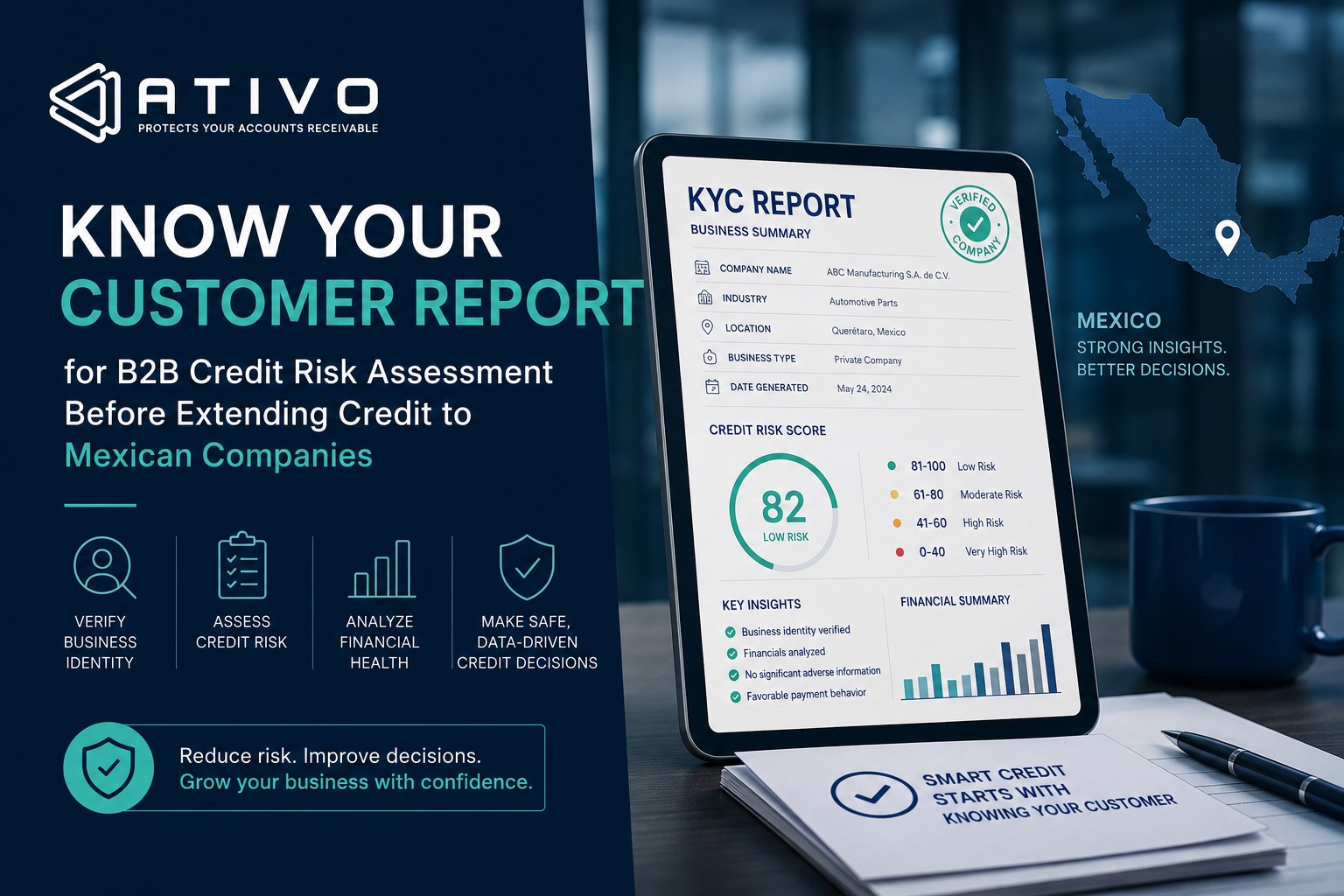

📋 A KYC in Mexico — Know Your Customer report — is the most cost-effective risk management tool available to any company extending B2B credit in the Mexican market. It provides the financial, legal, and commercial intelligence needed to decide who to extend credit to, under what terms, and with what exposure limit — before the invoice is issued and before default becomes a problem. This article explains what a KYC report in Mexico contains, when to run one, and how it protects your cash flow at the moment of highest leverage: before the credit is granted.
Are you extending credit in Mexico without a KYC report on your buyer?
→ Request a KYC report on your Mexican client — ATIVOWhat Is a KYC in Mexico and Why Does It Matter for B2B Credit Sales?
In the Mexican B2B credit market, extending credit without a KYC in Mexico is the equivalent of approving a loan without checking a credit score. Every invoice issued on credit terms is a financial exposure — and the only variable that determines whether that exposure will be recovered on time, recovered late, or written off is the quality of the information the creditor had at the moment of granting credit.
A KYC report — Know Your Customer — is a structured intelligence document that provides a comprehensive view of a Mexican company's payment behavior, financial health, legal standing, and operational structure. It answers the questions that every credit manager needs to answer before approving a credit sale:
- Does this company have the capacity to pay at the agreed maturity?
- Does this company have a history of paying on time — or a pattern of default?
- Is there active litigation against this company that affects its assets or solvency?
- Is the company's RFC active and SAT-compliant — or has it been flagged?
- What is its D&B credit score in the Mexican market?
Without a credit report Mexico B2B, the answers to these questions are either absent or based on the debtor's own representations — which is not a credit decision; it is a commercial bet. As we explore in our guide on how to detect accounts receivable problems before they become collection cases, the single highest-ROI intervention in the entire credit-to-cash cycle is the risk assessment made before the invoice is issued.
What a KYC in Mexico Contains: 6 Intelligence Modules
A professional KYC in Mexico is not a single data point — it is a multi-module intelligence report that combines commercial, financial, fiscal, and legal information about the target company. The six modules below define what a comprehensive Know Your Customer report in the Mexican B2B context should contain.

The intelligence from these six modules allows a credit manager to move from empirical credit decisions — "they seem like a reliable buyer" — to defensible credit decisions: ones that can be justified to management, auditors, or a court if the credit eventually requires judicial recovery.
Need a KYC report on a Mexican company before extending credit?
→ Request your KYC report — ATIVO delivers in business daysKYC in Mexico: What the Report Reveals and Why Each Signal Matters
A KYC in Mexico does not simply confirm that a company exists — it reveals the risk profile of extending credit to that company at a specific credit limit and payment term. The table below maps the most common KYC findings to their credit risk implications:
| KYC finding | Risk level | Recommended credit response |
|---|---|---|
| RFC inactive or SAT-flagged | 🔴 HIGH | Do not extend credit — request regularization before any transaction |
| Active commercial litigation involving significant assets | 🔴 HIGH | Limit exposure; require pagaré; escalate review before approval |
| D&B score below sector average, history of late payment | 🟠 MEDIUM | Reduce credit limit; shorten payment terms; require pagaré |
| Address unverifiable or mismatched with RFC | 🟠 MEDIUM | Pause approval; request address verification before proceeding |
| Strong D&B score, clean litigation history, SAT active | 🟢 LOW | Approve with standard terms; document with signed credit agreement |
| New company, limited credit history | 🟠 MEDIUM | Start with limited credit; require pagaré; review after 3–6 months |
When to Run a KYC in Mexico: 5 Situations That Require One
A customer credit check Mexico should not be a reactive measure — it should be built into the credit approval process as a standard step. These five situations define when a KYC report is non-negotiable:
KYC in Mexico as Bad Debt Prevention: The ROI Calculation
The cost of a KYC in Mexico is measured in hundreds of dollars. The cost of an uncollectable invoice — including the direct write-off, the collection effort, the legal fees if pursued judicially, and the cash flow impact — is measured in multiples of the invoice value. The ROI of pre-credit KYC is not a theoretical argument; it is the most straightforward financial calculation in the credit risk management toolkit.
Companies that integrate a systematic KYC process into their credit approval workflow consistently achieve:
- Lower bad debt provisions as a percentage of credit sales
- Shorter Days Sales Outstanding (DSO) — because credit is extended to clients who pay on time
- Stronger judicial recovery outcomes on the accounts that do go overdue — because the documentation is already in order and the debtor's assets are already known
- More defensible credit decisions in the event of a dispute or audit
As we explore in our guide on key strategies for bad debt recovery in Mexico, a KYC run at the point of credit approval is the single highest-ROI intervention in the credit cycle — not because it prevents all defaults, but because it prevents the ones that were predictable, and it positions the creditor optimally for the ones that aren't.
Frequently Asked Questions — KYC in Mexico
What is a KYC in Mexico and what does it contain?
A KYC in Mexico — Know Your Customer report — is a structured intelligence document that provides a comprehensive view of a Mexican company's creditworthiness and risk profile. It typically contains: general commercial information (size, history, operations), financial capacity analysis (liquidity, payment behavior), D&B credit score, a national search for civil and commercial litigation, RFC and SAT compliance status, and address verification with asset validation. It is the primary tool for making defensible B2B credit decisions in the Mexican market before extending credit, increasing a credit limit, or evaluating a debtor who has stopped paying.
When should a company run a KYC in Mexico?
The five situations that require a KYC in Mexico are: (1) before extending credit to any new Mexican client; (2) before increasing an existing client's credit limit; (3) when a long-standing client shows payment warning signs; (4) when a debtor becomes unresponsive to collection follow-up; and (5) as part of an annual credit portfolio review on high-exposure accounts. Running a KYC at the moment of credit approval — not after the first late payment — is the highest-value use of the report.
Can a KYC in Mexico prevent bad debt?
A KYC in Mexico cannot guarantee payment, but it significantly reduces the probability of extending credit to clients who will default — and it dramatically improves recovery outcomes when a client does default. Companies that systematically run KYC reports on new credit applicants achieve lower bad debt provisions, shorter DSO, and stronger judicial recovery outcomes than those that rely on empirical credit decisions. The report also provides the debtor information that collection specialists need if the account eventually requires active recovery.
What is the difference between a KYC report and a credit report in Mexico?
In Mexico's B2B context, the terms are often used interchangeably, but a comprehensive KYC in Mexico goes beyond a standard credit report. A credit report focuses primarily on payment history and credit score (typically D&B or buró de crédito empresarial). A full KYC report adds legal proceedings searches, RFC and SAT compliance verification, address and asset validation, and qualitative commercial analysis — providing a more complete picture of the debtor's risk profile for B2B credit decisions.
Know your Mexican customer before the credit is extended — not after the invoice is overdue.
→ Request a KYC report on your Mexican client from ATIVO