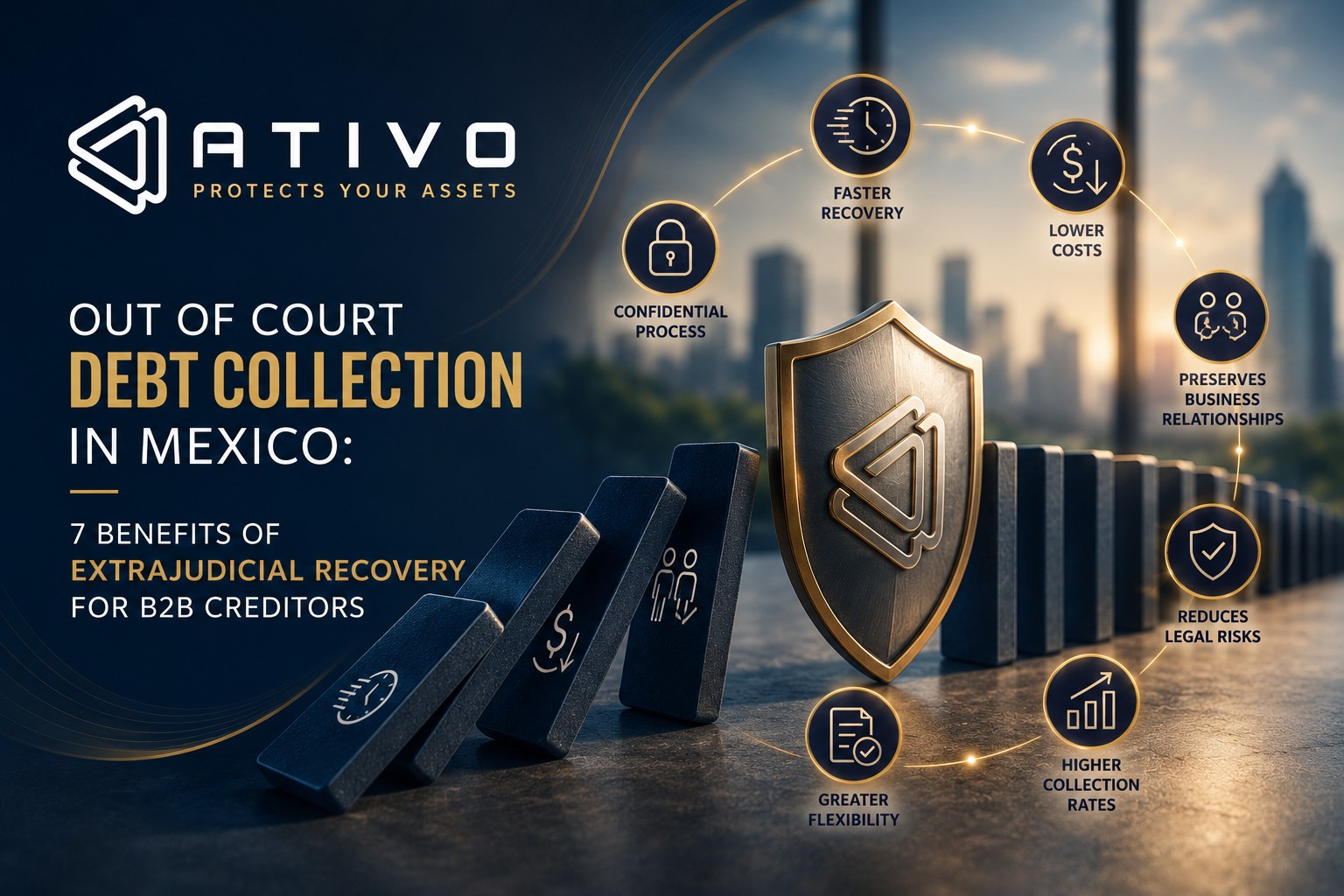

⚖️ Out of court debt collection in Mexico resolves between 70% and 80% of B2B commercial accounts without a lawsuit — faster, at lower cost, and without the relationship damage that litigation invariably produces. For international companies managing overdue receivables in Mexico, understanding exactly what out-of-court collection delivers, how it works, and when it should give way to judicial escalation is the foundation of any rational debt recovery strategy.
Is your company managing overdue accounts in Mexico without a structured collection process?
→ Get a free portfolio assessment from ATIVO — no upfront feesWhat Is Out of Court Debt Collection in Mexico?
Out of court debt collection in Mexico — also called extrajudicial collection — is the process of recovering overdue B2B invoices through direct negotiation, formal demand letters, and binding payment agreements, without initiating court proceedings. It operates entirely outside the judicial system: no lawsuit is filed, no court is involved, and no judge issues a ruling.
The term "out of court" can be misleading — it does not mean informal or unstructured. A professional extrajudicial collection service Mexico follows a precisely defined escalation sequence, with documented contacts, legally grounded demand letters, and formalized payment agreements that create executable instruments for immediate judicial enforcement if the debtor defaults. The difference from litigation is not rigor — it is speed, cost, and the preservation of optionality.
7 Key Benefits of Out of Court Debt Collection in Mexico for B2B Creditors

Are these seven benefits applicable to accounts in your Mexico portfolio right now?
→ Talk to an ATIVO specialist — no upfront fees, bilingual managementOut of Court Debt Collection in Mexico vs. Litigation: When to Use Each
The question is not "extrajudicial or judicial" — it is "extrajudicial first, with a defined judicial escalation path ready." The two are not competing strategies; they are sequential phases of the same recovery process. As we detail in our guide on when to negotiate vs. litigate on a commercial debt in Mexico, the optimal approach is always to exhaust extrajudicial options first — then transition to judicial action without changing providers, losing case context, or resetting timelines.
- Debt under 180 days overdue with locatable debtor
- Commercial relationship worth preserving
- Debtor shows some responsiveness
- No imminent prescription deadline
- Creditor prefers no-upfront-fee model
- International client needs bilingual reporting
- Debtor unresponsive after 60–90 days of structured extrajudicial contact
- Debtor defaults on a signed payment agreement
- Prescription deadline on pagaré within 180 days
- Asset transfer or fraud indicators present
- Creditor holds pagaré enabling embargo preventivo from day 1
How Out of Court Debt Collection in Mexico Works: 4 Stages
A professional out of court debt collection Mexico process is not a series of phone calls — it is a structured, documented, legally grounded escalation sequence. As we explore in our guide on how extrajudicial debt collection services in Mexico protect your accounts receivable, the four-stage process defines the operational reality of professional collection.
As we detail in our article on alternatives for recovering overdue accounts receivable in Mexico, the provider that manages both extrajudicial and judicial phases under one structure eliminates the single most common failure point in commercial collection: the handoff.
Frequently Asked Questions — Out of Court Debt Collection in Mexico
What is out of court debt collection in Mexico and how is it different from litigation?
Out of court debt collection in Mexico — extrajudicial collection — is the process of recovering overdue B2B invoices through direct negotiation, formal demand letters, and binding payment agreements without filing a lawsuit. Litigation involves initiating court proceedings — most commonly the juicio ejecutivo mercantil — which takes 6 to 18 months, incurs upfront legal costs, and typically ends the commercial relationship. Extrajudicial collection resolves 70–80% of B2B cases in 30 to 90 days on a success-fee basis. The two are not alternatives — they are sequential phases, with extrajudicial always first and judicial as the defined escalation path when extrajudicial is exhausted.
How much does out of court debt collection in Mexico cost?
A legitimate out of court collection service Mexico operates on a success-fee model: a percentage of the recovered amount, charged only when recovery occurs. There is no upfront retainer and no fee for cases where nothing is recovered. The percentage varies by debt age, case complexity, and portfolio volume. This model fully aligns the provider's financial incentive with the creditor's recovery outcome — structurally different from a law firm that bills retainers and hourly fees regardless of result.
Can out of court debt collection in Mexico recover debts from companies that refuse to pay?
Yes — through a combination of professional pressure, reputational leverage, and the credible signal of judicial escalation. A debtor who understands that the next step is a juicio ejecutivo mercantil with asset seizure has a strong financial incentive to negotiate. A professional out of court debt collection Mexico specialist makes that escalation path visible and credible from the first contact — which is why it produces results that informal internal follow-up cannot. When the debtor is genuinely unresponsive after structured extrajudicial efforts, the judicial escalation is activated without changing providers or losing the case context built during the extrajudicial phase.
When should a company switch from out of court collection to litigation in Mexico?
Four scenarios define when out of court debt collection in Mexico should transition to judicial proceedings: (1) the debtor has not responded to any structured extrajudicial contact after 60–90 days; (2) the debtor has defaulted on a signed payment agreement; (3) the prescription deadline on the pagaré is within 180 days; (4) there is credible evidence of asset transfer or bad-faith behavior. Once the prescription deadline expires — 3 years for a pagaré, 6 months for a check — the right to litigate is permanently lost. A specialist who tracks prescription deadlines proactively and transitions to judicial action before that window closes is the structural advantage of an integrated provider over a reactive internal collection process.
Recover your overdue accounts in Mexico — without upfront fees, without litigation, without losing the relationship.
→ Get a free out of court collection assessment from ATIVO