
🖨️ Managing accounts receivable in Mexico's printing and lithographic industry means navigating long supplier relationships, high-value production credit, and debtors whose cash flow constraints are real — not bad faith. This is the story of how Litografía D'Ortega recovered a three-year-old overdue account through a process that aligned the interests of both parties, restructured the debt through legally grounded agreements, and ended with the debtor actively requesting to resume the commercial relationship.
Do you have overdue accounts receivable in Mexico that need structured recovery?
→ Get a free portfolio assessment from ATIVO — no upfront feesClient Profile: Litografía D'Ortega — Accounts Receivable in Mexico's Lithographic Industry
The Challenge: 3 Years of Overdue Accounts Receivable in Mexico's Printing Sector
When Litografía D'Ortega came to ATIVO, the overdue account had been accumulating for three years. The debtor company was not acting in bad faith — they were experiencing genuine cash flow constraints that had progressively made full payment impossible while informal patience from Litografía allowed the balance to grow without structured resolution. This is a pattern that consistently appears in accounts receivable in Mexico's manufacturing and production sectors: long-standing commercial relationships, high-value credit extended on trust, and reluctance to escalate that transforms a temporary liquidity problem into a multi-year collection case.
Three years of inaction had created a specific set of challenges: the debtor's financial position had evolved, the original payment terms were no longer viable, and the relationship — which both parties wanted to preserve — had been strained by the unresolved obligation. Standard demand letters and payment reminders had not produced results. What was needed was a structured intervention that could understand both parties' positions and create a path to resolution that neither side had been able to find independently.
As we explore in our guide on how to detect accounts receivable problems in Mexico before they require specialist intervention, the warning signs present in this case — progressive payment delays, cash flow conversations, communication going informal — are consistently present months before a case reaches the three-year overdue mark. Earlier intervention would have produced a faster, less complex resolution. But earlier intervention was not what happened here, and ATIVO's mandate was to work with the situation as it existed.
How ATIVO Approached Accounts Receivable Recovery in Mexico for Litografía D'Ortega
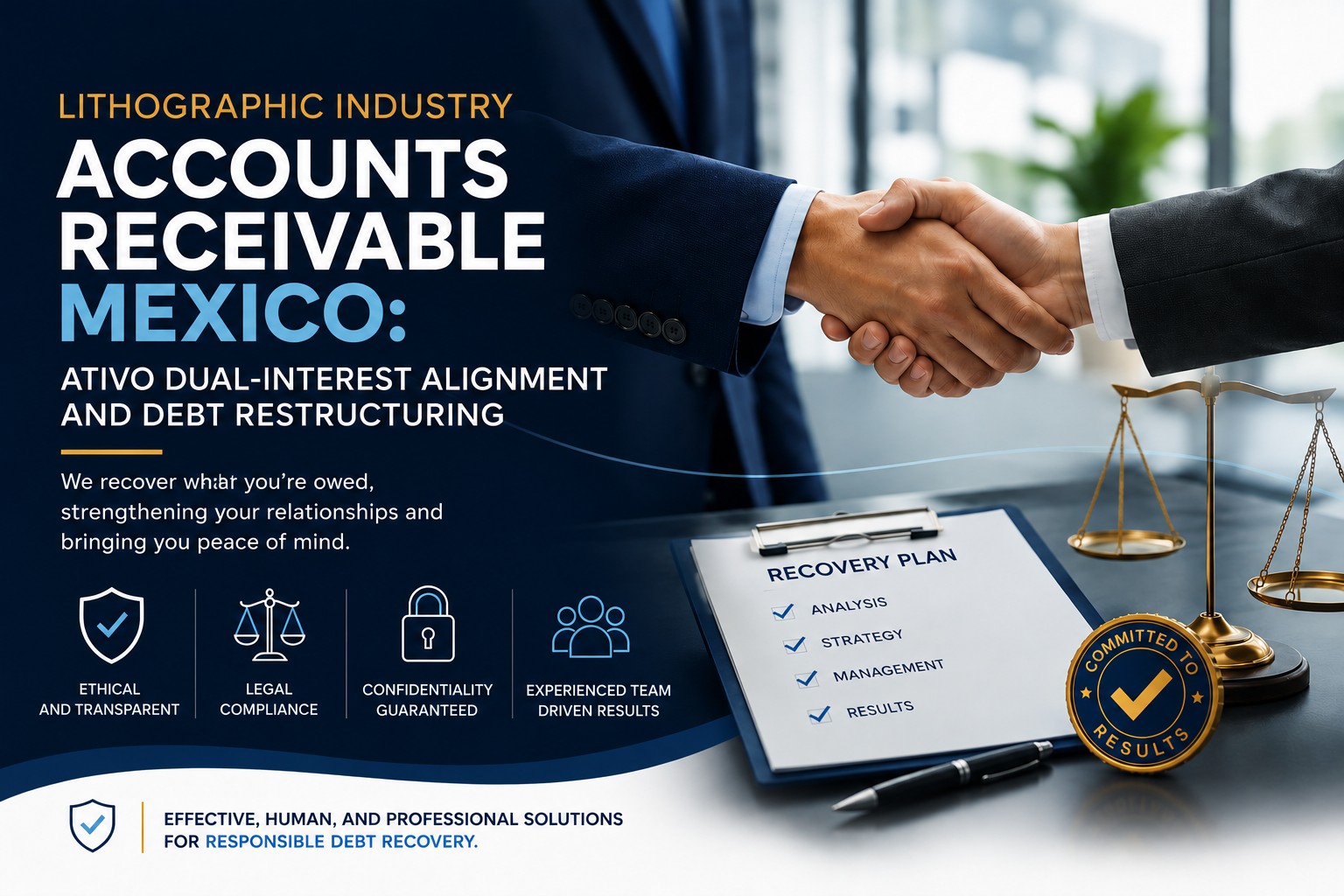
What distinguished ATIVO's approach in this case was the recognition that standard collection pressure — demand letters, payment ultimatums, judicial threats — was not the right first tool for a situation where the debtor was genuinely constrained and the commercial relationship had value to both parties. The strategy was built around alignment rather than confrontation.
Results: What Accounts Receivable Recovery in Mexico Delivered for Litografía D'Ortega
ATIVO conducted a comprehensive investigation to align the interest of both parties, guiding successful negotiations on the account. Our client achieved complete satisfaction by strategically restructuring their debt through effective agreements and legal measures, even amidst challenging accounts receivable conditions within the lithographic industry. The debtor company expressed gratitude for ATIVO's intervention, with their representatives eager to resume commercial relations with Litografía upon resuming operations.
Accounts Receivable in Mexico's Lithographic and Printing Industry: Sector-Specific Dynamics
The Litografía D'Ortega case reflects dynamics that are structurally common in Mexico's printing and lithographic sector. Four characteristics consistently define accounts receivable management Mexico challenges in this industry:
As we explore in our article on key strategies for bad debt recovery in Mexico, the structural challenge in sector cases like this is not the collection itself — it is the timing of intervention. Companies that engage a specialist early, before accounts age beyond 60 days, consistently achieve faster and less complex resolutions than those who extend informal patience for months or years.
Do you have overdue accounts in Mexico that require interest alignment and structured recovery?
→ Contact ATIVO — free portfolio assessment, no upfront feesFrequently Asked Questions — Accounts Receivable in Mexico: Lithographic Industry
What makes accounts receivable recovery in Mexico's lithographic industry particularly challenging?
Four dynamics create specific complexity in accounts receivable in Mexico's printing and lithographic sector: long-term supplier relationships that create reluctance to escalate; high single-invoice values that amplify the financial impact of overdue accounts; cash flow volatility in debtor operations (whose payment capacity depends on their own client cycles); and relationship value worth preserving — where adversarial collection would destroy more commercial value than the debt itself. Effective recovery in this sector requires an approach that understands all four dynamics, as the Litografía D'Ortega case demonstrates.
What is dual-interest alignment in accounts receivable management in Mexico?
Dual-interest alignment is a collection approach that structures the recovery process around the shared interests of both the creditor and the debtor — rather than purely around the creditor's demand. In the Litografía D'Ortega case, both parties had an interest in resolution: Litografía needed recovery; the debtor needed a viable compliance path that preserved their commercial standing. ATIVO's investigation identified these shared interests and structured a debt restructuring that both parties could accept — producing complete recovery, a binding legal agreement, and a debtor who expressed gratitude rather than resentment. This approach is most effective when both parties have long-term commercial reasons to preserve the relationship.
Can accounts receivable in Mexico be recovered after 3 years of non-payment?
Yes — as the Litografía D'Ortega case demonstrates — but the approach must be adapted to the debtor's actual situation and the time elapsed. The critical factor is whether the prescription deadline remains intact: commercial invoices in Mexico typically have a 10-year prescription window under the Código de Comercio, so three-year-old accounts remain legally actionable in most cases. The practical challenge is that debtors with multi-year payment failures have typically developed complex financial situations that require investigation and creative structuring rather than standard payment demands. Professional extrajudicial accounts receivable management Mexico with sector expertise can often find recovery paths that appear blocked from a conventional collection perspective.
How does ATIVO's approach to accounts receivable in Mexico preserve the commercial relationship?
ATIVO's approach to accounts receivable recovery in Mexico in relationship-sensitive cases begins with investigation rather than pressure — understanding the debtor's actual constraints before determining the collection strategy. When both parties have a shared interest in preserving the commercial connection, the negotiation is structured around compliance paths the debtor can realistically fulfill, backed by formal legal agreements that protect the creditor's interests. The outcome — as in the Litografía D'Ortega case — is a recovery that leaves the debtor with gratitude rather than resentment, and a commercial relationship that can resume rather than one that has been permanently closed by an adversarial proceeding.
Do you have overdue accounts receivable in Mexico that need a structured recovery approach?
→ Get a free assessment from ATIVO — interest alignment, no upfront fees