

⏰ In the Mexican B2B credit market, trade credit risk does not stay constant — it grows. Every day that an unpaid invoice ages without active management, the probability of full recovery decreases, the legal options narrow, and the financial cost of the delay increases. Time is the variable that most reliably converts a manageable receivable into an unrecoverable loss.
Is your company extending trade credit in Mexico without a structured risk strategy?
→ Get a free assessment from ATIVOTrade Credit Risk in Mexico: The 4 Ways Time Amplifies an Unpaid Invoice
How Trade Credit Risk in Mexico Escalates Over Time
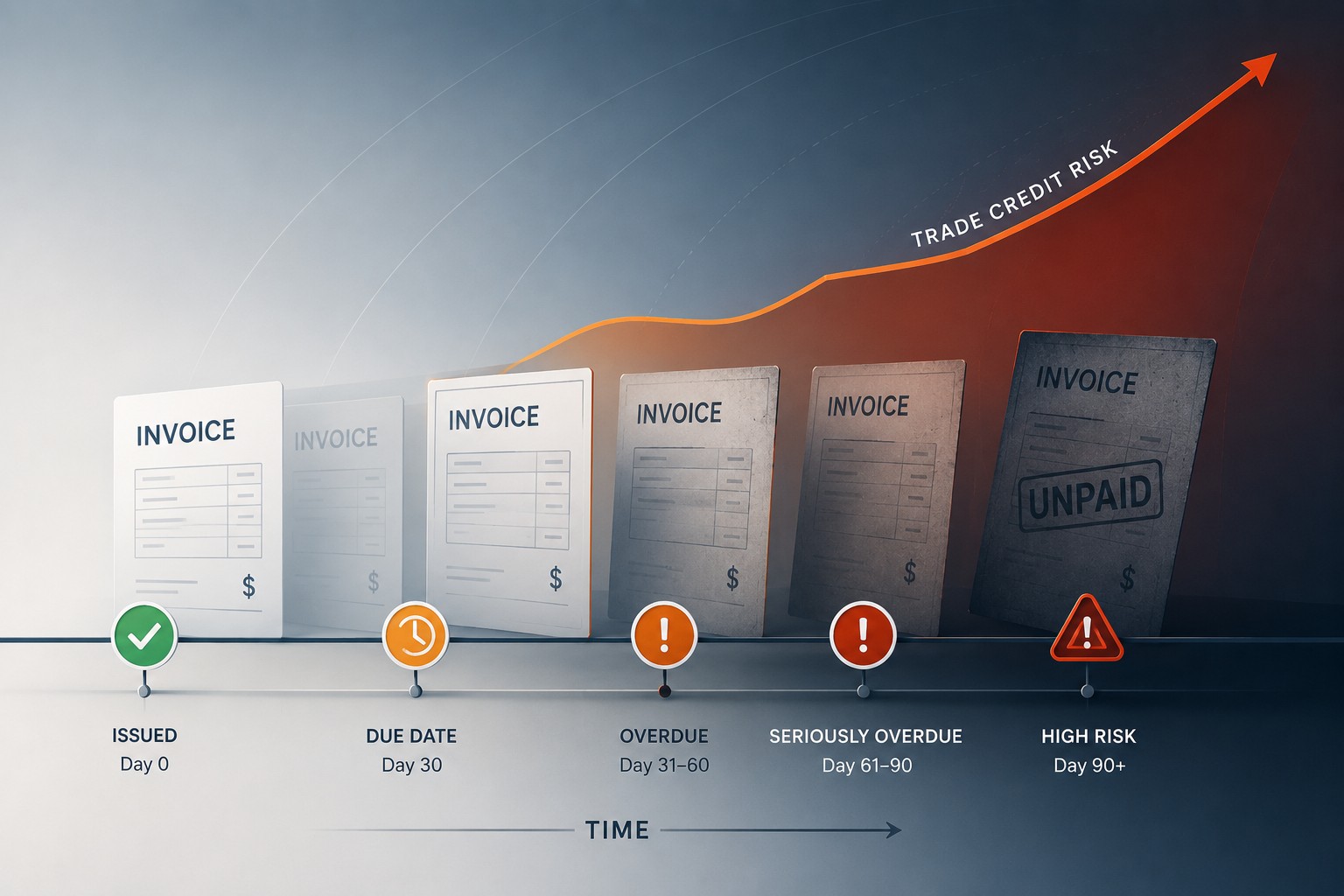
The four factors above compound. An invoice 30 days overdue presents moderate trade credit risk Mexico: the real value erosion is small, the prescription deadline is distant, the reputational impact is limited, and the FX exposure is contained. An invoice 180 days overdue presents a fundamentally different risk profile: the real value has eroded, the prescription window has narrowed, and the debtor's responsiveness has declined.
As we explore in our article on managing debts in Mexico before they become a cash flow crisis, the companies that manage trade credit risk most effectively act early — not because they are more aggressive, but because they understand that time is the variable that most reliably converts a manageable receivable into an unrecoverable loss.
Is a prescription deadline approaching for a debt in your Mexico portfolio?
→ Act now — the window closes permanentlyThe Prescription Deadline: The Legal Dimension of Trade Credit Risk in Mexico
The prescription deadline is the single most important time-based constraint in trade credit risk Mexico — and the most frequently overlooked. As we detail in our article on key strategies for bad debt recovery in Mexico, proactive prescription deadline management is non-negotiable.
The practical requirements for every portfolio:
What to Do When Trade Credit Risk Becomes a Collection Problem
As we detail in our article on alternatives for recovering overdue accounts receivable in Mexico, the three recovery paths are determined by where the case sits in the timeline:
- Extrajudicial collection — Direct negotiation, demand letters, payment agreements. Most effective within the first 60 days. No lawsuit required. Preserves the commercial relationship.
- Juicio ejecutivo mercantil — The fastest judicial instrument when the creditor holds a pagaré or qualifying contract. Allows asset seizure from day one. Must be initiated before the prescription deadline.
- Juicio ordinario mercantil — For cases without an executable title. Longer process, higher evidentiary burden, but valid for documented debts where the prescription deadline is still intact.
The decision between paths is not only strategic — it is time-constrained. The prescription deadline determines which options remain available at any given moment in your trade credit risk Mexico portfolio.
Preventing Trade Credit Risk in Mexico Before It Occurs
The most effective trade credit risk Mexico strategy is the one that prevents bad debt from entering the portfolio. Running KYC and credit risk reports on Mexican companies before extending credit provides the intelligence to make defensible credit decisions — RFC and SAT status, corporate structure, D&B score, litigation history, and payment behavior references.
Companies that integrate credit risk assessment into their approval process enter fewer relationships that eventually require active collection — and when they do, the documentation is already in order for both extrajudicial and judicial proceedings.
Frequently Asked Questions — Trade Credit Risk Mexico
What is trade credit risk in Mexico and why does time make it worse?
Trade credit risk in Mexico is the probability that a commercial obligation will not be paid on time or in full. Time amplifies this risk through four mechanisms: inflation erodes the real value of the outstanding amount; prescription deadlines eliminate the right to litigate after a defined period; delayed payments damage the debtor's credit reputation; and foreign currency exposure adds exchange rate volatility. All four grow with time — making early action the highest-value intervention.
What is the prescription deadline for collecting a commercial debt in Mexico?
Under the Mexican Commercial Code: 3 years for a promissory note (pagaré), 6 months for a check, and typically 10 years for a commercial invoice or contract-based obligation. Once the invoice collection deadline Mexico passes, the right to judicial collection is permanently lost — regardless of the amount owed or the debtor's capacity to pay.
When should a company take legal action to collect a corporate debt in Mexico?
Before the prescription deadline expires and after extrajudicial collection efforts have been exhausted — typically at 60 to 90 days of delinquency if the debtor is unresponsive. The juicio ejecutivo mercantil allows asset seizure from the first day of proceedings when the creditor holds an executable title, giving significant leverage before the debtor has time to transfer assets.
How can a company reduce trade credit risk when selling to Mexican businesses?
The primary risk reduction tools are: (1) credit risk assessment before extending credit; (2) executable documentation — promissory notes (pagarés) or contracts with enforceable default clauses; (3) proactive monitoring and systematic follow-up on overdue accounts; and (4) prescription deadline tracking for every account in the portfolio. Companies that implement all four consistently achieve lower bad debt rates and better recovery outcomes.
Manage trade credit risk in Mexico before time runs out.
→ Get a free assessment from ATIVO