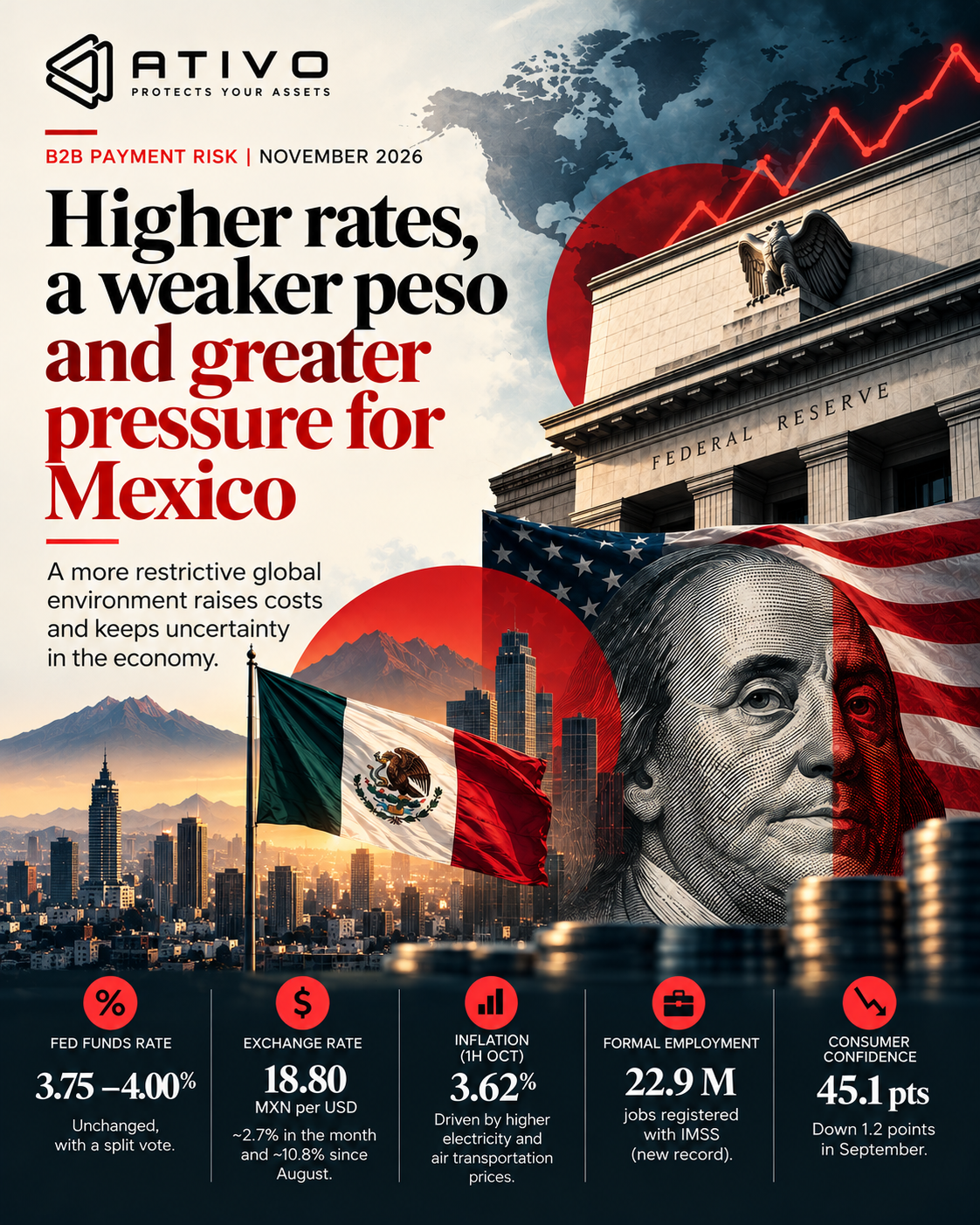

November opens with a fourth quarter that concentrates the year's greatest liquidity pressures on Mexican businesses: the peso reached ~18.80 MXN/USD, its weakest level since late 2025, representing a cumulative depreciation of ~10.8% from August. The Fed paused on October 28 — but with a divided vote and signals of a potential December hike — headline inflation rose to 3.62% in the first half of October driven by energy prices, and consumer confidence fell another 1.2 points to 45.1 points in September. For companies extending B2B trade credit, November is the month where year-end payment problems are created — not where they arrive.
Executive Summary of Mexico's Economic Activity
On October 28, the Federal Reserve held its benchmark rate at the 3.75–4.00% range, but with a divided vote: two governors voted to raise rates by an additional 25 basis points. The Fed stated that "inflation remains elevated" and did not rule out action in December. The Mexico–U.S. rate differential remains at just 250 basis points — the cycle low — eliminating Banxico's room to cut further. Financing costs remain high on both sides of the border.
The Mexican peso is trading around 18.80 MXN/USD, its weakest level since late 2025, with a monthly depreciation of ~2.7% and a cumulative depreciation of ~10.8% since August. Headline annual inflation accelerated to 3.62% in the first half of October (INEGI), driven by electricity (+18.51%) and air travel (+14.77%). Core services inflation rose 0.31% in the fortnight. The combination of a depreciated peso and rising energy inflation increases operating costs for any business with dollar-denominated inputs or liabilities.
Formal employment reached a new record in September with 22.9 million IMSS-registered workers (+128,803 in the month), but the average registered wage fell by MXN 7.1 in a single month. The Consumer Confidence Index dropped to 45.1 points in September (INEGI), a decline of 1.2 points from August. Manufacturing business confidence stands at 48.0 points — 18 consecutive months below the 50-point threshold, signaling persistent pessimism in the productive sector. Overall economic activity (IGAE) grew 3.3% annually in August, with momentum driven by services while manufacturing continues to lag.
Key Indicators
- Headline annual inflation: 3.62% — first half of October (INEGI); acceleration from September.
- Banxico benchmark rate: 6.50% — extended pause; no change expected through at least 2027 (Citi survey).
- Fed funds rate: 3.75–4.00% — held October 28, divided vote; possible December hike.
- Mexico–U.S. rate differential: 250 basis points — cycle low, structural pressure on the peso.
- Exchange rate: ~18.80 MXN/USD — ~2.7% monthly depreciation; ~10.8% cumulative since August.
- Formal employment (IMSS): 22.9 million workers — September 2026 record (+128,803 in the month).
- Consumer Confidence Index (ICC): 45.1 points in September (INEGI) — down 1.2 points from August.
- Business Confidence (ICE manufacturing): 48.0 points — 18 consecutive months below 50 (INEGI).
- IGAE August 2026: +3.3% annual — services-led growth; manufacturing continues to underperform (INEGI).
Default Risk Outlook by Sector
Manufacturing & Transformation Industry — 🔴 High Risk
18 consecutive months of business confidence below 50, combined with a peso that has depreciated ~10.8% since August, erode the cash flow of textiles, metallurgy, and auto parts companies. Exporters see their peso-denominated margins shrink as dollar revenues no longer offset rising import costs.
Companies with Dollar Debt or Imported Inputs — 🔴 High Risk
With the peso at ~18.80 MXN/USD, any dollar-denominated liability or supply contract carries a significantly higher peso cost than in August. Companies without FX hedging face a structural gap between peso revenues and dollar obligations that directly pressures their capacity to pay suppliers on time.
Construction & Building Materials Supply — 🔴 High Risk
The Economic Package 2027 spending cuts are materializing in November as stalled projects, non-renewed contracts, and delayed payments from public-sector clients. Materials distributors with government contractor exposure carry the highest concentration risk in any B2B portfolio right now.
Wholesale Trade Tied to Domestic Consumption — 🟡 Moderate-High Risk
Consumer confidence at 45.1 points and persistent energy and food inflation reduce end-consumer purchasing power, leading to smaller orders and higher probability of payment term renegotiations across distribution chains.
Public Sector & Government-Linked Companies — 🟡 Moderate Risk
Budget adjustment under the 2027 package is already producing payment delays in some agencies. Risk is concentrated in medium-term service contracts without exchange rate adjustment clauses — a structural gap that will widen as the peso remains weak.
Essential Consumer Goods, Healthcare & Basic Services — 🟢 Low Risk
Structurally stable demand and better relative payment behavior. Not immune to energy cost inflation or import price pressure, but their risk profile remains the most manageable in a B2B trade credit portfolio.
Three Warning Signals in B2B Credit Operations
- Your manufacturing, construction, or government-sector client closed October with incomplete payments or extension requests and has no documented justification: in November, that pattern signals that year-end is already tightening their liquidity — not that it might.
- The buyer has significant dollar-denominated obligations — credit lines, equipment, raw materials — and the 18.80 exchange rate was not in their budget: the difference between MXN 17.00 in August and 18.80 today represents a 10.6% increase in their cost structure that was not provisioned for.
- You detect changes in the accounts payable contact, invoice confirmation email, or registered bank account: in the current year-end pressure context, these shifts can signal an internal payment restructuring or an undisclosed cash flow problem before it surfaces formally.
Key Recommendation
⚡ November is the month where year-end payment problems are created — not where they arrive. Activate preventive collection across your B2B portfolio now: confirm that all October invoices are registered in your client's system, verify outstanding balances before November 15, and schedule follow-up calls with key accounts payable contacts — without waiting for due dates. With the peso at 18.80 and a possible Fed hike in December, your buyers are absorbing pressures they don't always communicate proactively. Acting now is the difference between collecting this year and starting the next one in recovery mode.
Conclusion
Mexico enters November 2026 with a peso at 18.80, high rates on both sides of the border, and a 2027 budget that is already tightening public spending. Companies extending B2B trade credit should reinforce their portfolio management this month: activate preventive collection, review credit limits by client, and consider partnering with accounts receivable specialists before year-end delays become unrecoverable balances.
Is your B2B portfolio ready to close the year? Let's talk.
→ Request Your Free Consultation with ATIVO📧 info@ativo-mx.com · 📞 +52 55-7583-9900
ATIVO — Collection Specialist in Mexico. We represent international creditors in the recovery of B2B debt with Mexican companies. Free initial consultation available.