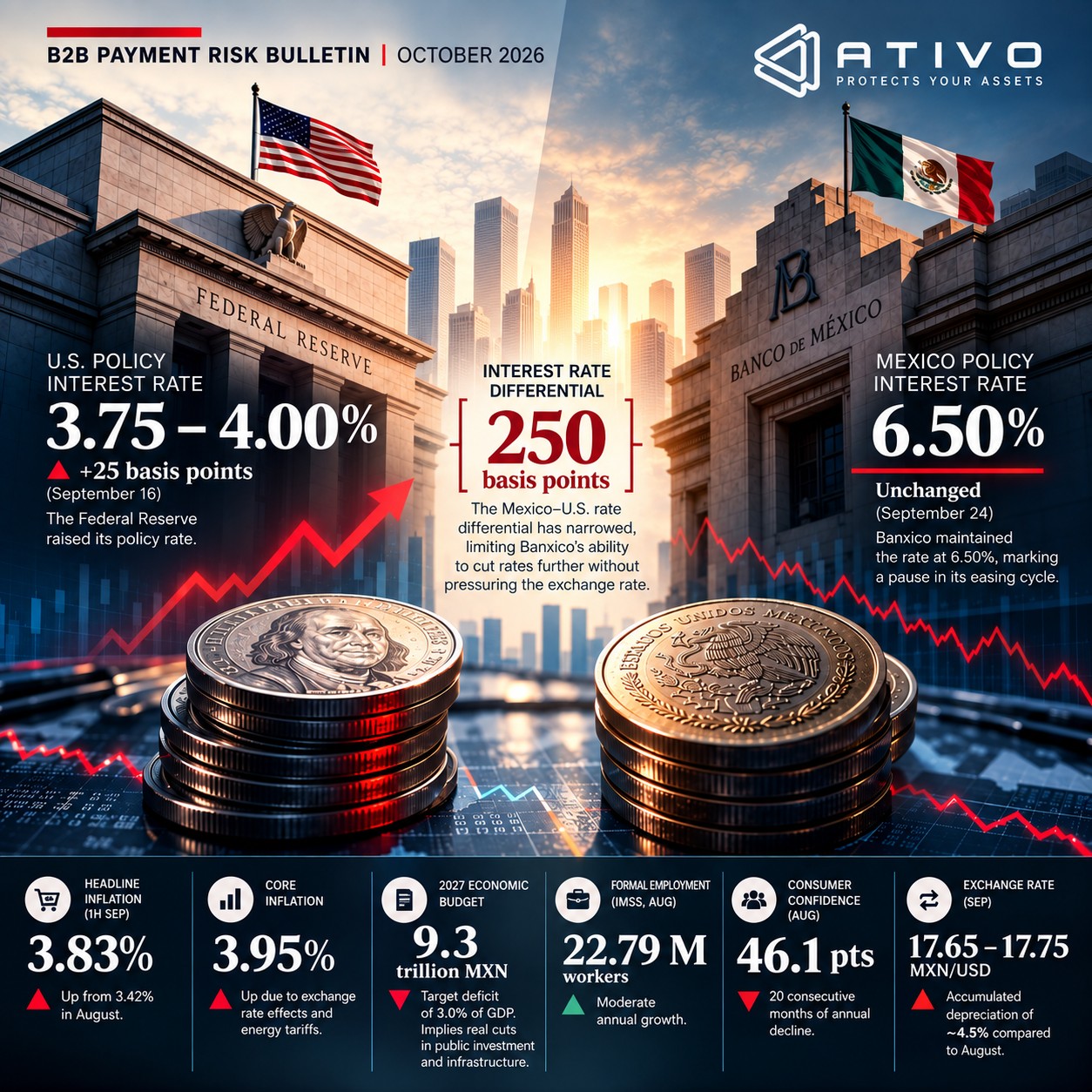

October arrives with four structural shifts that are reconfiguring B2B trade credit risk in Mexico: the Fed raised its benchmark rate 25 basis points on September 16 to the 3.75–4.00% range, Banxico held at 6.50% on September 24 with a conditional tone, headline inflation accelerated to 3.83% in the first half of September, and the peso has depreciated notably to the 17.65–17.75 MXN/USD range. Adding to this monetary backdrop is the Economic Package 2027, which implies additional cuts to public spending. Companies extending B2B trade credit need to adjust their risk analysis before year-end.
Executive Summary of Mexico's Economic Activity
On September 16, the U.S. Federal Reserve raised its benchmark rate by 25 basis points to the 3.75–4.00% range. A week later, on September 24, Banco de México voted to hold its rate at 6.50%, marking a pause in the easing cycle. Banxico's statement noted that the Mexico–U.S. rate differential has compressed to just 250 basis points, limiting its capacity to cut further without putting pressure on the exchange rate. Financing will remain expensive for Mexican businesses throughout the fourth quarter.
Headline annual inflation reached 3.83% in the first half of September and 3.42% in August (INEGI), with core inflation rising to 3.95%. The Economic Package 2027 presented in September targets total federal spending of MXN 9.3 trillion with a deficit target of 3.0% of GDP — significantly below the 2024 deficit — implying real cuts to public investment and infrastructure with direct impact on construction and government-linked sectors.
Formal employment reached 22.79 million IMSS-registered workers in August. The Consumer Confidence Index stood at 46.1 points in August (INEGI), marking 20 consecutive months of annual decline — the longest streak since the pandemic. The exchange rate operated in the 17.65–17.75 MXN/USD range, with an accumulated depreciation of approximately 4.5% versus August levels. For companies with dollar-denominated debt or significant imported inputs, the financial cost has risen directly.
Key Indicators
- GDP Q2 2026: +0.6% quarterly / +1.1% annual (INEGI).
- Headline inflation: 3.83% first-half September / 3.42% August annual (INEGI).
- Banxico benchmark rate: 6.50% — conditional pause (Sept 24, 2026).
- Fed funds rate: 3.75–4.00% — +25 bp hike (Sept 16, 2026).
- Mexico–U.S. rate differential: 250 basis points — cycle low.
- Formal employment (IMSS): 22.79 million workers — August 2026.
- Consumer Confidence Index: 46.1 points — 20 consecutive months of annual decline (INEGI).
- Economic Package 2027: MXN 9.3 trillion spending · 3.0% GDP deficit target.
- Exchange rate: ~17.65–17.75 MXN/USD — ~4.5% depreciation vs. August.
Default Risk Outlook by Sector
Manufacturing & Transformation Industry — 🔴 High Risk
Seven of the last eight quarters posted annual declines. The Fed hike raises dollar-denominated borrowing costs for exporters and increases the cost of imported machinery and inputs. Textiles, metallurgy, and auto parts are operating with compressed margins and payment cycles under pressure.
Companies with Dollar Debt or Imported Inputs — 🔴 High Risk
The ~4.5% peso depreciation since August directly raises the financial cost for any company with U.S.-dollar liabilities or purchases. Companies without FX hedging face immediate cash flow pressure and reduced payment capacity, regardless of their sector.
Construction & Building Materials Supply — 🔴 High Risk
The Economic Package 2027 spending cuts hit public works portfolios directly. Materials distributors with exposure to government contractors must urgently review their credit terms before year-end. Restrictive financing rates add a further squeeze on project cash flows.
Public Sector & Government-Linked Companies — 🟡 Moderate-High Risk
Suppliers and service providers to federal agencies or state-owned enterprises face payment delays as budget adjustments materialize. Risk is highest for companies with concentrated exposure to agencies with confirmed cuts in the 2027 package.
Wholesale Trade Tied to Domestic Consumption — 🟡 Moderate Risk
Twenty consecutive months of declining consumer confidence signal a more cautious year-end spending environment. Core inflation at 3.95% continues to erode purchasing power, generating payment deferrals and renegotiations of agreed trade terms.
Essential Consumer Goods, Healthcare & Basic Services — 🟢 Low Risk
Structurally more stable demand and relatively better payment behavior. Not immune to input cost pressures from inflation or the peso depreciation, but their risk profile remains the most manageable in a B2B trade credit portfolio.
Three Warning Signals in B2B Credit Operations
- Your buyer operates in construction, manufacturing, or government services and has recently requested extended terms, split payments, or due-date adjustments without a clear business justification — in a context of public spending cuts, these requests are rarely isolated.
- The buyer carries significant dollar-denominated debt or imports and has no FX hedging in place: the ~4.5% peso depreciation since August is already impacting their real cash flow, even if they haven't formally communicated it.
- You detect recent changes in accounts payable contacts, tax address, or registered bank accounts, particularly in clients with high revenue concentration in one or two government contracts or a single exporting customer.
Key Recommendation
⚡ In October, year-end becomes an active risk variable. Activate preventive collection before invoices come due across all manufacturing, construction, and government-linked accounts: confirm formal receipt of goods or services, verify that invoices are logged in your client's system, and update your key accounts payable contacts. A weakened peso, high rates, and spending cuts are three simultaneous pressures your buyers are absorbing right now — and the first thing they adjust when cash flow tightens is payments to suppliers. Is your B2B receivables portfolio ready to close the year without surprises?
Conclusion
Mexico enters Q4 2026 with higher rates on both sides of the border, a depreciated peso, and a 2027 budget that reduces public spending. Companies extending B2B trade credit should strengthen their per-client risk analysis — particularly in manufacturing, construction, and government-linked sectors — prioritize preventive collection, and consider partnering with accounts receivable specialists before year-end delays escalate into written-off balances.
Get ahead of default risk. Let's talk about your accounts receivable.
→ Request Your Free Consultation with ATIVO📧 info@ativo-mx.com · 📞 +52 55-7583-9900
ATIVO — Collection Specialist in Mexico. We represent international creditors in the recovery of B2B debt with Mexican companies. Free initial consultation available.