
Mexico enters June 2026 with confirmed economic contraction, inflation still above target, and consumer confidence in a 15-month downtrend. In this environment, extending trade credit between businesses demands greater due diligence, proactive monitoring, and sharper collection strategies.
Executive Summary of Mexico's Economic Activity
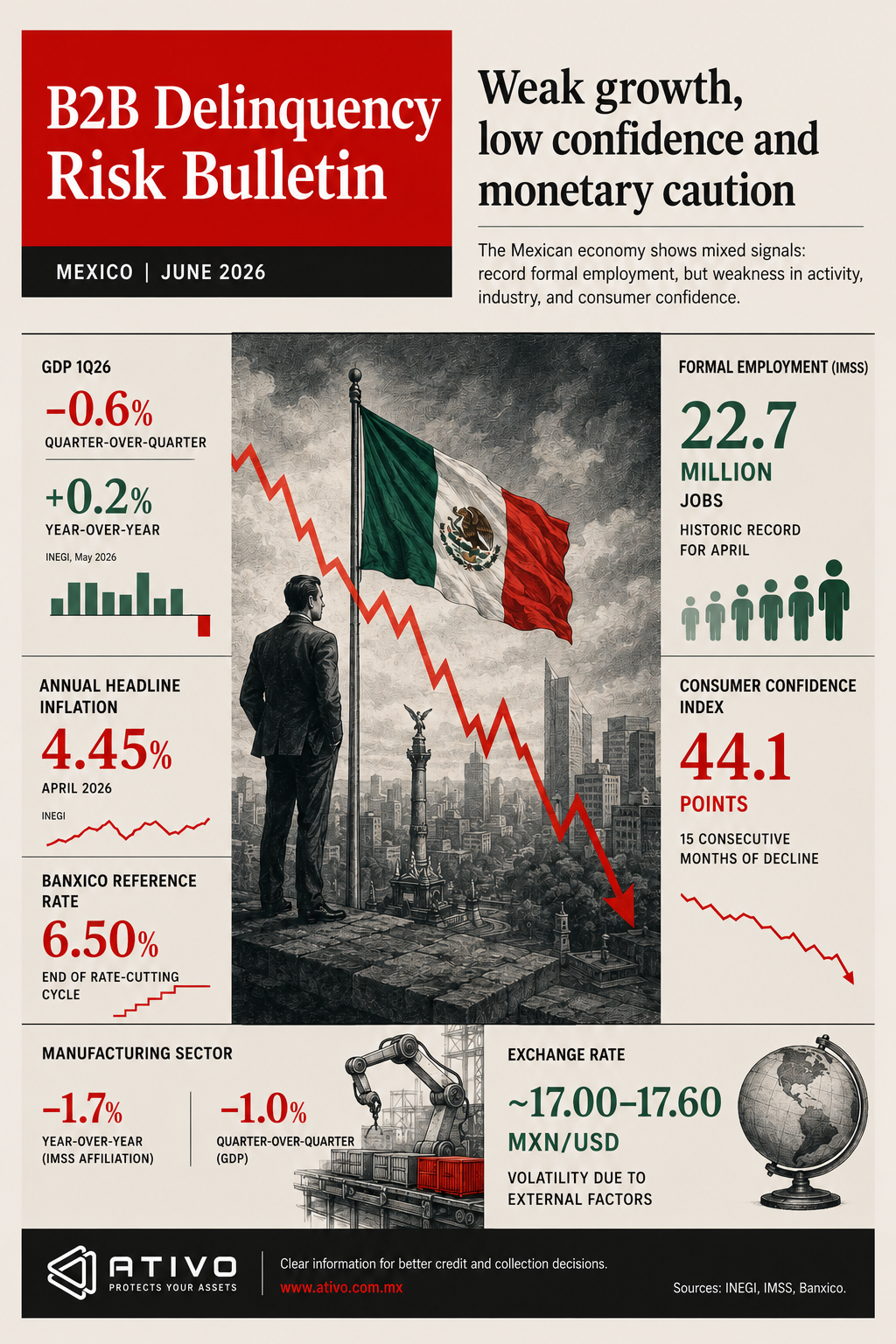
INEGI confirmed that Mexico's GDP contracted 0.6% on a quarterly basis in Q1 2026 — the weakest performance in five quarters — with simultaneous declines across primary, secondary, and tertiary sectors. Manufacturing and the transformation industry fell 1.0% quarter-over-quarter, weighed down by U.S. tariff policy and supply chain disruptions tied to the conflict in the Middle East.
Annual headline inflation stood at 4.45% in April, marking the first deceleration of the year, yet remaining well above Banxico's 3% target. On May 7, the Bank of Mexico delivered its final rate cut of the current easing cycle, bringing the benchmark rate to 6.50% and signaling an extended pause. Financing conditions will remain restrictive for businesses throughout June.
On the labor front, the IMSS reported 22.7 million registered jobs at the close of April — a record for that month — though manufacturing employment fell 1.7% year-over-year. The Consumer Confidence Index declined to 44.1 points in March, extending its consecutive annual decline to 15 months. The exchange rate is hovering between MXN 17.00 and 17.60 per U.S. dollar, with volatility episodes driven by ongoing geopolitical uncertainty.
Key Indicators
- GDP Q1 2026: -0.6% quarterly / +0.2% annual (INEGI, May 2026).
- Annual headline inflation: 4.45% in April (INEGI).
- Banxico benchmark rate: 6.50% — end of the easing cycle.
- Formal employment (IMSS): 22.7 million jobs — all-time record for April.
- Consumer Confidence Index: 44.1 points — 15 consecutive months of annual decline.
- Manufacturing: -1.7% annual decline in IMSS enrollment; -1.0% quarterly in GDP.
- Exchange rate: ~MXN 17.00–17.60/USD, with volatility from external factors.
Default Risk Outlook by Sector
Manufacturing & Transformation Industry — 🔴 High Risk
Seven of the last eight quarters have posted annual declines. Textiles, metallurgy, and auto parts are under mounting liquidity and margin pressure from U.S. tariffs and slowing order volumes.
Agriculture & Agro-Industry — 🔴 High Risk
The steepest quarterly GDP contraction in Q1 2026 (-1.7%) directly impacts agricultural input suppliers and processors. Extended collection cycles and high exposure to volatile commodity prices elevate credit risk significantly.
Construction & Building Materials Supply — 🟡 Moderate-High Risk
Restrictive financing rates and reduced public investment are squeezing project cash flows. Materials distributors maintain portfolios with high exposure to buyers operating on limited working capital.
Wholesale Trade Tied to Domestic Consumption — 🟡 Moderate-High Risk
A 15-month slide in consumer confidence and food inflation at 6.36% annually compress margins and generate payment deferrals across wholesale distribution channels.
Transportation & Logistics — 🟡 Moderate Risk
High sensitivity to fuel costs and industrial cargo volume. The manufacturing slowdown directly reduces freight revenues and cash flow predictability.
Essential Consumer Goods, Healthcare & Basic Services — 🟢 Low Risk
More stable demand and comparatively better payment behavior, though not immune to input cost pressures driven by persistent inflation.
Three Warning Signals in B2B Credit Operations
- Your buyer operates in manufacturing, agro-industry, or construction and has recently requested extended terms, split payments, or due-date adjustments without a clear business justification.
- Recent changes in accounts payable contacts, tax address, or banking information, combined with slower post-delivery communication or delays in invoice confirmation.
- The buyer is heavily dependent on one or two end customers — particularly exporters or companies tied to the automotive supply chain — making them directly exposed to order slowdowns from the U.S.
Key Recommendation
⚡ Throughout June, activate preventive collection before invoices come due: confirm formal receipt of goods or services, verify that invoices are logged in your client's system, and update your key accounts payable contacts. In a contracting economy with tight credit conditions, early payment delays rarely announce themselves — they are managed. The difference between timely recovery and a written-off receivable almost always comes down to the speed of action.
Conclusion
Mexico enters June 2026 with a contracting economy, elevated financing costs, and consumer confidence at recent lows. Companies extending B2B trade credit should strengthen their per-client risk analysis, prioritize preventive collection, and consider partnering with specialists in accounts receivable management before delays escalate into unrecoverable balances.
Get ahead of default risk. Let's talk about your accounts receivable.
→ Request Your Free Consultation with ATIVO📧 info@ativo-mx.com · 📞 +52 55-7583-9900
ATIVO — Collection Specialist in Mexico. We represent international creditors in the recovery of B2B debt with Mexican companies. Free initial consultation available.