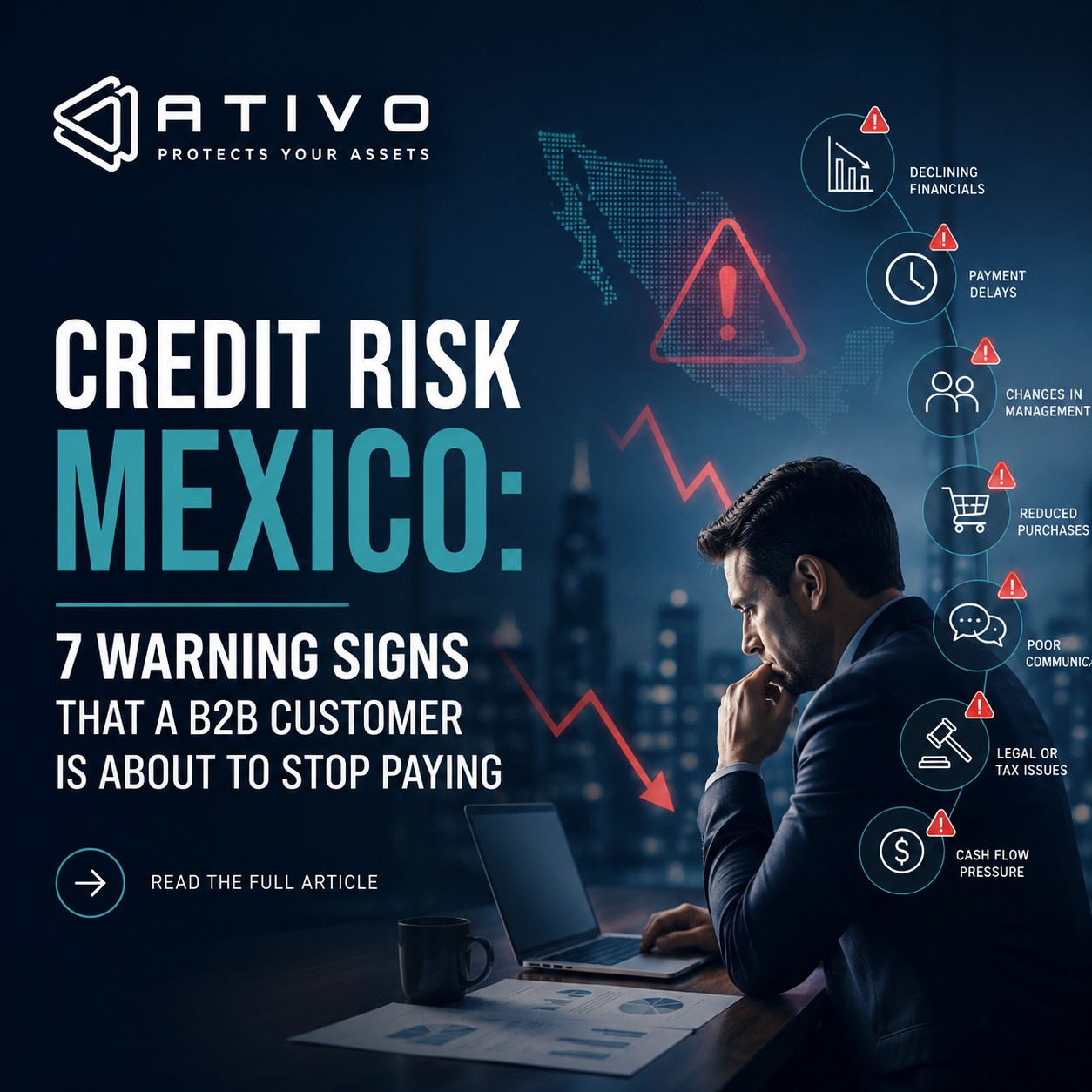

⚠️ Credit risk Mexico rarely announces itself. A Mexican B2B buyer who is about to default does not send a notification — they send increasingly creative reasons for not paying on time. The challenge is detecting the early behavioral signals that indicate a buyer's payment behavior is deteriorating before the invoice goes formally overdue.
Seeing warning signs in a Mexican B2B client?
→ Get a free credit risk assessment from ATIVO before the debt goes overdueWhy credit risk Mexico is harder to detect than in other markets
The payment culture gap that conceals emerging default risk
In many B2B markets, a missed payment deadline is a clear signal that breaks an established norm. In Mexico, where 60 to 90-day payment terms are standard and informal extension requests are common even among solvent buyers, the baseline behavior is already flexible. This makes credit risk Mexico particularly difficult to detect early: the signals that would trigger alarm elsewhere are normalized behavior in the Mexican B2B context.
The information asymmetry problem in Mexican B2B credit
Mexico's commercial credit information infrastructure is less transparent than that of the US or most European markets. Credit bureau data is available through Buró de Crédito Empresarial but does not capture all payment relationships — particularly with smaller creditors or in informal credit arrangements. This means payment risk Mexican buyers can deteriorate significantly before it becomes visible in standard credit score data. The most reliable early warning signals are behavioral — observable in the pattern of a buyer's interactions with the creditor.
How to assess credit risk Mexico before extending credit to a new buyer
The most cost-effective point to identify credit risk Mexico is before the first invoice is issued. As we detail in our guide on KYC Mexico reports for B2B buyer credit risk assessment, a verified KYC report covers RFC and SAT compliance, corporate structure, D&B credit score, national litigation search, payment behavior references from credit suppliers, and asset verification — providing the intelligence needed to make a defensible credit decision before any exposure is created. For existing clients, the seven warning signs below perform the equivalent function for ongoing commercial credit risk assessment Mexico.

Credit risk Mexico in your existing portfolio: the 7 warning signs
As we detail in our guide on 6 tips for B2B credit operations in Mexico that minimize default risk, the most actionable signals are observable in buyer behavior before the invoice is formally overdue. These seven warning signs are ordered by typical sequence of appearance:
Not sure which warning signs in your portfolio deserve immediate action?
→ ATIVO assesses your case — free, no obligationWarning sign severity: how to classify and respond to each signal
When warning signs become a collection problem: what to do next
As we detail in our article on B2B bad debt recovery strategies in Mexico when warning signs are ignored, when credit risk Mexico has advanced to a missed payment, the recovery window by debt age is:
As we detail in our guide on recovery options when accounts receivable Mexico go overdue, the earlier the specialist engages, the higher the probability of full recovery and the lower the cost per peso recovered.
How ATIVO helps companies manage credit risk Mexico in their B2B portfolios
ATIVO provides credit risk Mexico management across the full credit and collection cycle: KYC and credit risk reports before credit is extended, portfolio health assessments for existing clients showing warning signs, structured extrajudicial collection for accounts 30–90 days overdue, and in-house juicio ejecutivo mercantil for cases requiring judicial enforcement — all managed in English and Spanish under a contingency-only fee structure.
Frequently asked questions about credit risk Mexico
What are the most reliable warning signs of credit risk in Mexico for B2B companies?
The seven most reliable credit risk Mexico warning signs are: (1) increasing payment cycle length, (2) repeated extension requests, (3) partial payments without an agreed schedule, (4) change in payment contact or authorization level, (5) declining responsiveness to routine communication, (6) disputes over invoices without substantive basis, and (7) SAT or RFC status changes. The presence of three or more signals simultaneously is a red-level indicator requiring immediate specialist engagement.
How is credit risk in Mexico different from credit risk in the US or Europe?
Credit risk Mexico is structurally harder to detect early because the baseline B2B payment culture already includes informal extension requests, longer payment cycles, and relationship-based communication patterns that in other markets would be considered warning signals. Additionally, Mexico's commercial credit bureau infrastructure does not capture all payment relationships, making behavioral signal monitoring more reliable than score-based monitoring.
When should I engage a collection specialist if I see credit risk warning signs in a Mexican buyer?
The optimal engagement window is when a buyer shows amber-level warning signs and has an invoice within 30 to 45 days of becoming overdue — or immediately when red-level signals appear. B2B default risk Mexico recovery rates decline significantly after 60 days overdue. Engaging at 30–45 days produces recovery rates 2 to 3 times higher than engaging at 90+ days, at a fraction of the cost.
Can I recover a debt from a Mexican buyer without a signed contract?
Yes. Extrajudicial collection can be initiated with any documentation evidencing the debt — invoices, delivery receipts, email acknowledgments, or partial payment records. For judicial recovery, a valid executive title (pagaré, enforceable contract clause, or check) is required under Mexico's Código de Comercio. If no formal title exists, a collection specialist can obtain a written payment agreement (convenio de reconocimiento de adeudo) during the extrajudicial process — which itself constitutes an enforceable instrument.
ATIVO: B2B credit risk Mexico assessment and debt collection. Detect the signals early. Act before the window closes.
→ Free B2B credit risk assessment — no upfront fees, no obligation