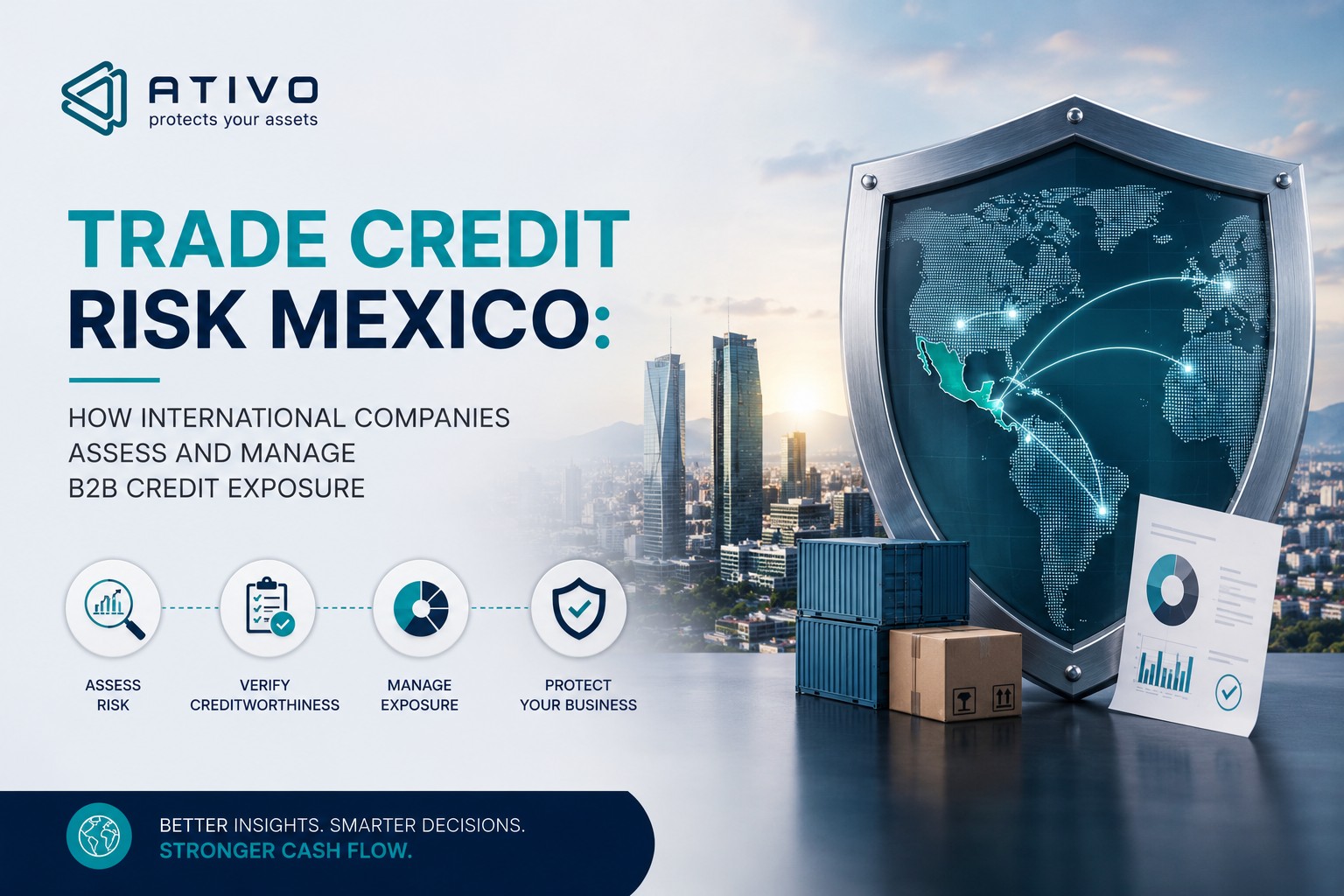

📊 Trade credit risk in Mexico is the probability that a Mexican B2B buyer will not pay an invoice on time — or at all. For international companies selling on credit terms to Mexican companies, managing this risk is not optional: it determines cash flow, liquidity, and the true profitability of Mexico operations.
Need to assess trade credit risk before extending credit to a Mexican buyer?
→ Request a KYC credit risk report from ATIVOWhat is trade credit risk in Mexico and why does it matter for international companies?
Trade credit risk Mexico is the financial exposure a company assumes when it sells goods or services to a Mexican buyer on deferred payment terms — before the invoice is collected. Unlike bank credit risk, which is managed through formal credit institutions, trade credit risk in B2B transactions is managed by the selling company itself: through credit policies, buyer due diligence, documentation, and collection processes.
In Mexico, trade credit is the primary financing mechanism in the B2B market — far more prevalent than bank lending for working capital purposes. This means international companies selling to Mexican buyers are, by extension, acting as credit providers to a market with specific legal, cultural, and commercial characteristics that increase the probability of payment delay compared to markets where credit enforcement is faster and cheaper.
Why Mexico-specific trade credit risk requires a dedicated approach
Three structural characteristics of the Mexican B2B credit market elevate trade credit risk for international sellers beyond what the same buyer profile would represent in other markets:
- Extended payment culture — 60 to 90-day payment terms are standard in many sectors, with informal extension requests common even among solvent buyers
- Judicial enforcement timeline — Judicial recovery in Mexico takes 6 to 18 months; the cost of enforcement is a disincentive for small and mid-size creditors
- Information asymmetry — International sellers rarely have access to verified credit information on Mexican buyers before extending terms
Trade credit risk Mexico: signals that indicate elevated exposure
As we analyze in our article on how debts in Mexico silently grow and affect your international portfolio, elevated trade credit risk rarely appears overnight — it develops through identifiable signals that most international creditors recognize only after the damage is done:
How to assess trade credit risk Mexico before extending credit: a 6-step framework
As we detail in our guide on KYC due diligence on Mexican companies before extending credit, a structured B2B credit risk assessment Mexico covers six dimensions — each providing information that is unavailable from the buyer's own representations:
Ready to assess trade credit risk before your next Mexico transaction?
→ Request a KYC credit risk report — fast turnaround, verified data
What to look for in an international accounts receivable partner for Mexico
Managing trade credit risk Mexico effectively requires a local partner who covers the full credit and collection cycle — not just recovery after the debt goes bad. As we explain in our article on recovery options when accounts receivable Mexico go overdue, the best partners integrate prevention, monitoring, and recovery in a single service model.
Trade credit risk Mexico and the prescription deadline: the hidden urgency
One of the most underestimated dimensions of trade credit risk in Mexico is the prescription deadline — the legally established window within which judicial recovery must be initiated. Under Mexico's Código de Comercio:
- Promissory note (pagaré) — 3 years from maturity date
- Check — 6 months from issue date
- Commercial contract or acknowledged invoice — typically 10 years
Once the prescription deadline expires, the right to initiate judicial collection is permanently lost — regardless of the amount owed, the quality of documentation, or the debtor's solvency. As we detail in our article on proven B2B debt recovery tips for the Mexican market, monitoring prescription deadlines across a portfolio of overdue accounts is one of the most consequential — and most frequently neglected — components of trade credit risk management Mexico.
How ATIVO manages trade credit risk Mexico for international partners
ATIVO provides integrated trade credit risk Mexico management for international B2B companies operating in the Mexican market — covering the full cycle from pre-credit due diligence to judicial enforcement:
- KYC credit risk reports — RFC, SAT, D&B, litigation, asset verification, and payment behavior references before you extend credit
- Extrajudicial collection — Structured recovery process resolving 70–80% of B2B overdue accounts without litigation, in 30 to 90 days
- Judicial escalation — In-house juicio ejecutivo mercantil when extrajudicial efforts reach their limit, with preventive asset seizure from day one
- Bilingual case management — All reporting in English, real-time case updates through our QUID platform
- Contingency-only fees — Collection services on success basis; KYC reports on fixed fee
📩 info@ativo-mx.com | 📞 55-7583-9900
→ Request your free trade credit risk assessment for Mexico — no upfront fees
Frequently asked questions about trade credit risk in Mexico
What is trade credit risk in Mexico and how does it affect international companies?
Trade credit risk Mexico is the probability that a Mexican B2B buyer will not pay an invoice on time — or at all. It affects international companies through reduced cash flow, increased DSO, and the cost of recovery when accounts go overdue. Mexico-specific factors that elevate trade credit risk include extended payment culture, 6–18 month judicial enforcement timelines, and limited access to verified buyer credit information for international sellers.
How can I assess trade credit risk before selling to a Mexican company on credit?
The most effective tool is a KYC credit risk report covering RFC and SAT compliance, corporate structure, D&B credit score in the Mexican market, national litigation history, payment behavior references from credit suppliers, and asset verification. Companies that run KYC before extending credit significantly reduce the volume of B2B credit risk assessment Mexico cases that eventually require active collection — and are better positioned for judicial recovery when they do.
What happens if trade credit risk materializes and a Mexican buyer doesn't pay?
The recovery path depends on the age of the debt and the documentation available. Extrajudicial collection — structured demand letters, direct negotiation, and binding payment agreements — resolves 70–80% of B2B cases without litigation in 30 to 90 days. If extrajudicial efforts fail, the juicio ejecutivo mercantil under Mexico's Código de Comercio allows preventive asset seizure from the first day of proceedings — provided a valid executive title (pagaré, enforceable contract, check) is available.
Is there a deadline for recovering a B2B debt in Mexico through the courts?
Yes. Mexico's Código de Comercio establishes prescription deadlines: 3 years for a promissory note (pagaré), 6 months for a check, and typically 10 years for a commercial contract or formally acknowledged invoice. Once the prescription deadline expires, the right to judicial collection is permanently lost — regardless of the amount owed. Monitoring prescription deadlines is one of the most critical components of commercial credit risk Mexico management for any international creditor.
ATIVO: trade credit risk management and B2B debt collection in Mexico for international companies.
→ Free initial assessment — no upfront fees, no obligation