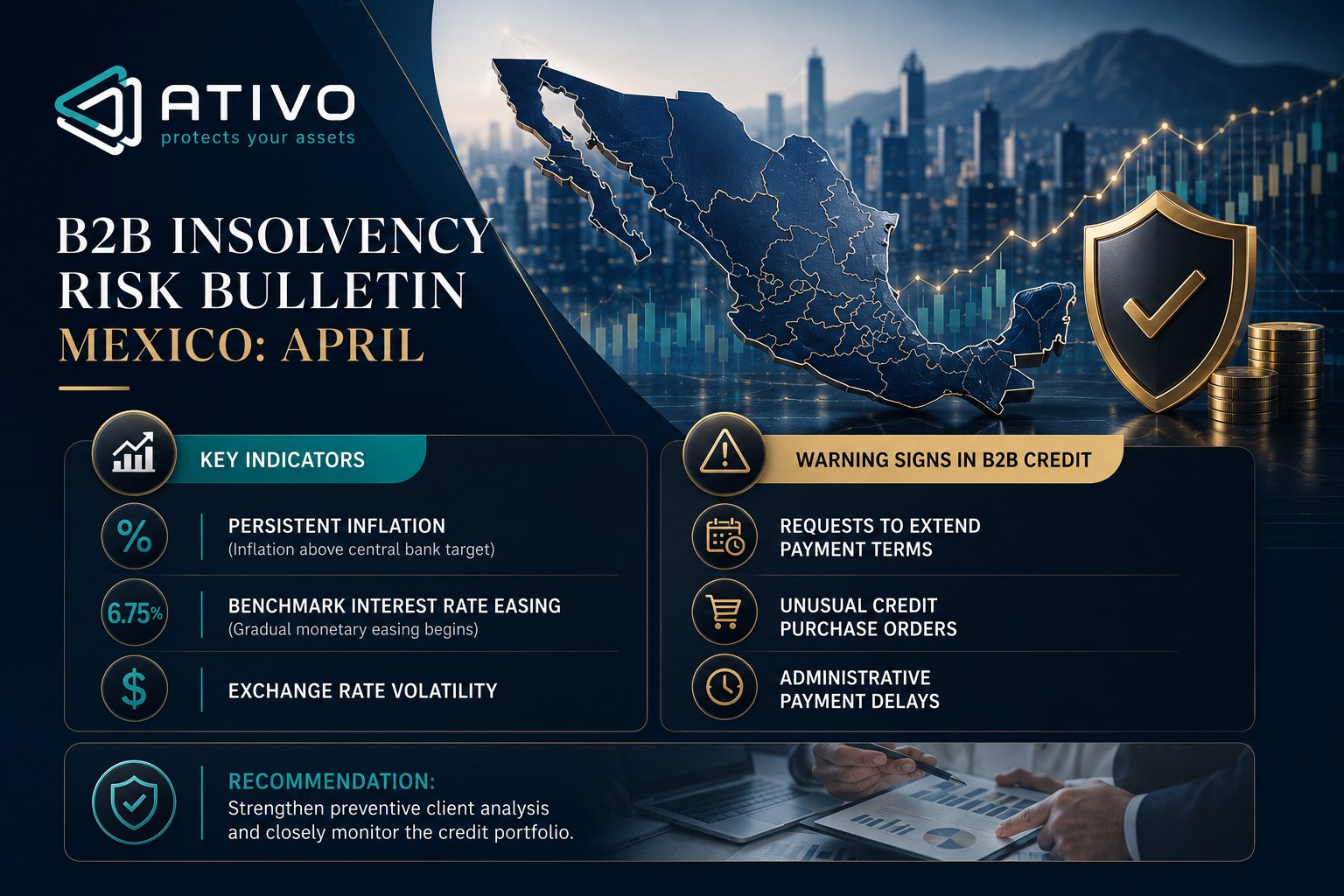

📊 Trade credit risk Mexico in April 2026 reflects a B2B credit environment shaped by three converging pressures: sustained uncertainty in global supply chains, tightening liquidity in key manufacturing and distribution sectors, and increasing payment extension requests from buyers who were current twelve months ago. For international companies with accounts receivable exposure in Mexico, these signals translate directly into DSO increases, payment delays, and — in the worst cases — write-offs on receivables considered low-risk at credit approval.
Is April trade credit risk Mexico affecting your B2B portfolio?
→ Get a free accounts receivable assessment from ATIVOApril 2026 trade credit risk Mexico: macroeconomic context
Key macro indicators affecting B2B credit in Mexico this month
Trade credit risk Mexico by industry: April 2026 sector signals
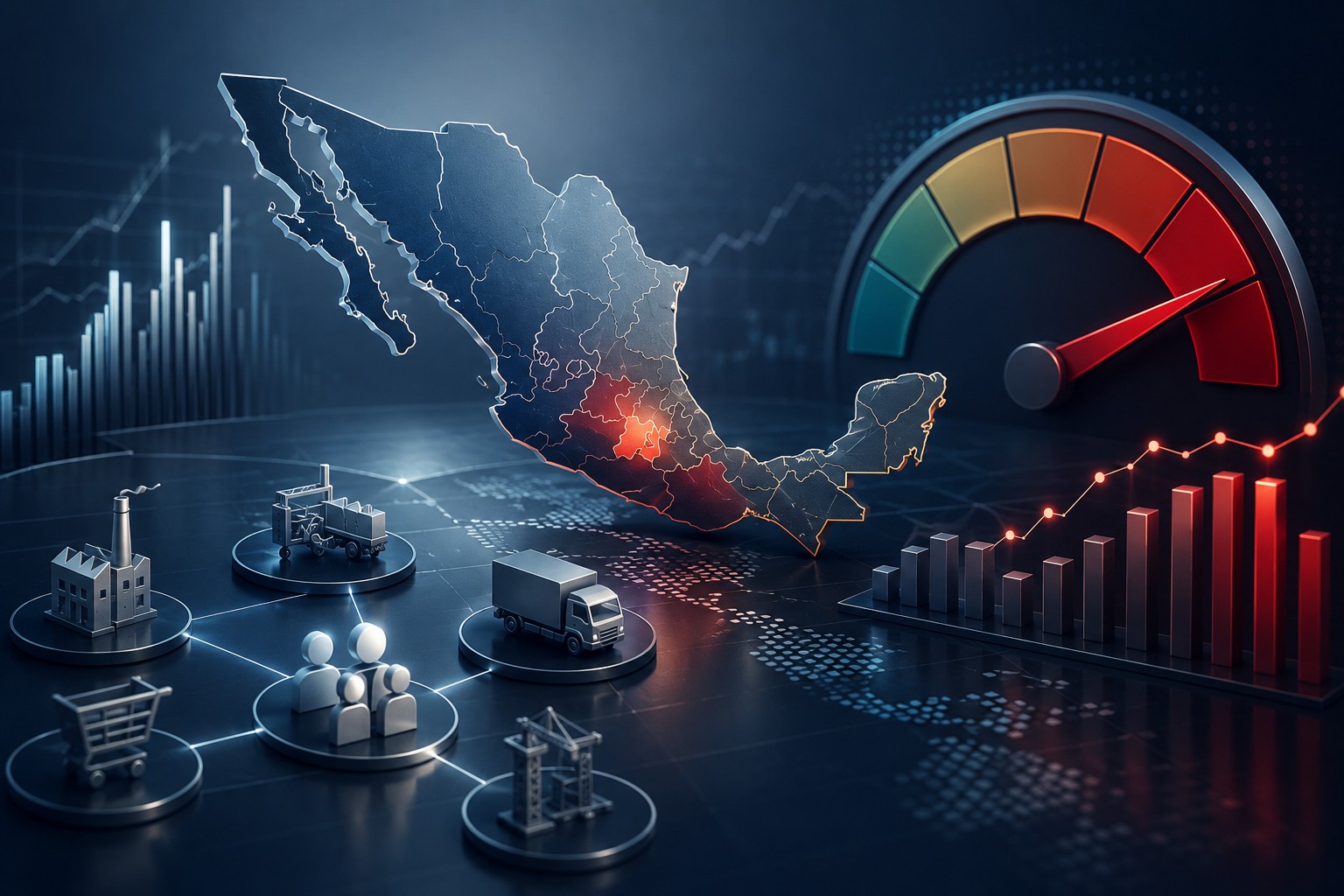
As we analyze in our article on how debts in Mexico grow unnoticed in B2B portfolios under rising trade credit risk, sector-specific dynamics are the most reliable leading indicator of trade credit risk Mexico deterioration:
7 early warning signs of trade credit risk Mexico in your B2B portfolio
As we detail in our article on 7 warning signs of credit risk Mexico in your B2B clients, the most reliable early indicators of trade credit risk Mexico materialization are behavioral:
Need to run KYC verification on a Mexican buyer showing April risk signals?
→ ATIVO delivers fast, verified intelligence — request nowHow to protect your accounts receivable from trade credit risk Mexico
As we detail in our guide on KYC Mexico reports to verify buyer creditworthiness before trade credit risk materializes, the specific actions for April 2026 conditions:
- KYC update on amber-risk accounts — For any existing buyer showing two or more warning signals, run an updated KYC report: current RFC and SAT status, updated D&B score, any new litigation proceedings. Stale intelligence in an environment where buyer risk profiles are changing rapidly is a liability.
- Formalize all payment agreements in writing — Convert any verbal payment commitment to a signed convenio de pago or, ideally, a promissory note (pagaré). A pagaré qualifies as an executive title under Mexico's Código de Comercio — enabling immediate asset seizure from the first day of juicio ejecutivo mercantil proceedings.
- Set prescription deadline alerts — Verify the prescription deadline for each receivable instrument in your portfolio: pagaré = 3 years from maturity, check = 6 months from issue. Missing these permanently eliminates the judicial option.
- Activate collection specialists at day 30, not day 90 — In elevated trade credit risk Mexico conditions, the window between day 30 and day 60 overdue is where the most collection value is created.
What to do when April trade credit risk Mexico materializes
As we detail in our guide on recovery options when accounts receivable Mexico go overdue, the action framework by debt age:
ATIVO April 2026 credit risk index: portfolio action recommendations
- Any Mexican buyer in construction or industrial manufacturing with two or more payment warning signals
- Any account with a pagaré approaching the 3-year prescription deadline
- Any buyer whose SAT status has changed since the last credit review
- Any buyer requesting a second consecutive payment extension in Q1/Q2 2026
- Any account in distribution or wholesale with a payment cycle increase of 15+ days vs. prior quarter
- Any buyer whose key financial contacts changed without explanation in the last 60 days
- Buyers in consumer-facing sectors with stable payment history and no warning signals
- Accounts with active pagaré documentation and payment cycles within contracted terms
Frequently asked questions about trade credit risk Mexico
What is trade credit risk Mexico and why is it elevated in April 2026?
Trade credit risk Mexico is the probability that a Mexican B2B buyer will not pay an invoice on time or at all. In April 2026, it is elevated above historical averages in several sectors due to: peso depreciation increasing input costs, SAT enforcement cycles competing with commercial payables, tighter domestic credit access, and nearshoring transition costs in northern Mexico manufacturing corridors creating new pockets of payment stress.
Which Mexican industries carry the highest trade credit risk in April 2026?
Based on April 2026 observable signals, the sectors with the highest B2B insolvency risk Mexico are: construction and real estate services (high), manufacturing and industrial supply chains (elevated), and distribution and wholesale trade (moderate-elevated). Food service and retail show more resilient payment behavior, with elevated individual account risk concentrated in mid-size operators outside major metropolitan markets.
How often should I update KYC reports on existing Mexican buyers given current trade credit risk Mexico levels?
In elevated trade credit risk Mexico conditions — like April 2026 — ATIVO recommends updating KYC reports on any existing buyer showing two or more payment warning signals, regardless of when the last report was run. For buyers in high-risk sectors (construction, industrial manufacturing), annual KYC updates are the minimum standard. For accounts with a payment cycle lengthening trend, an immediate update is more appropriate than waiting for the annual renewal cycle.
ATIVO monitors trade credit risk Mexico year-round — protecting B2B accounts receivable for international companies.
→ Free portfolio assessment — no upfront fees, no obligation