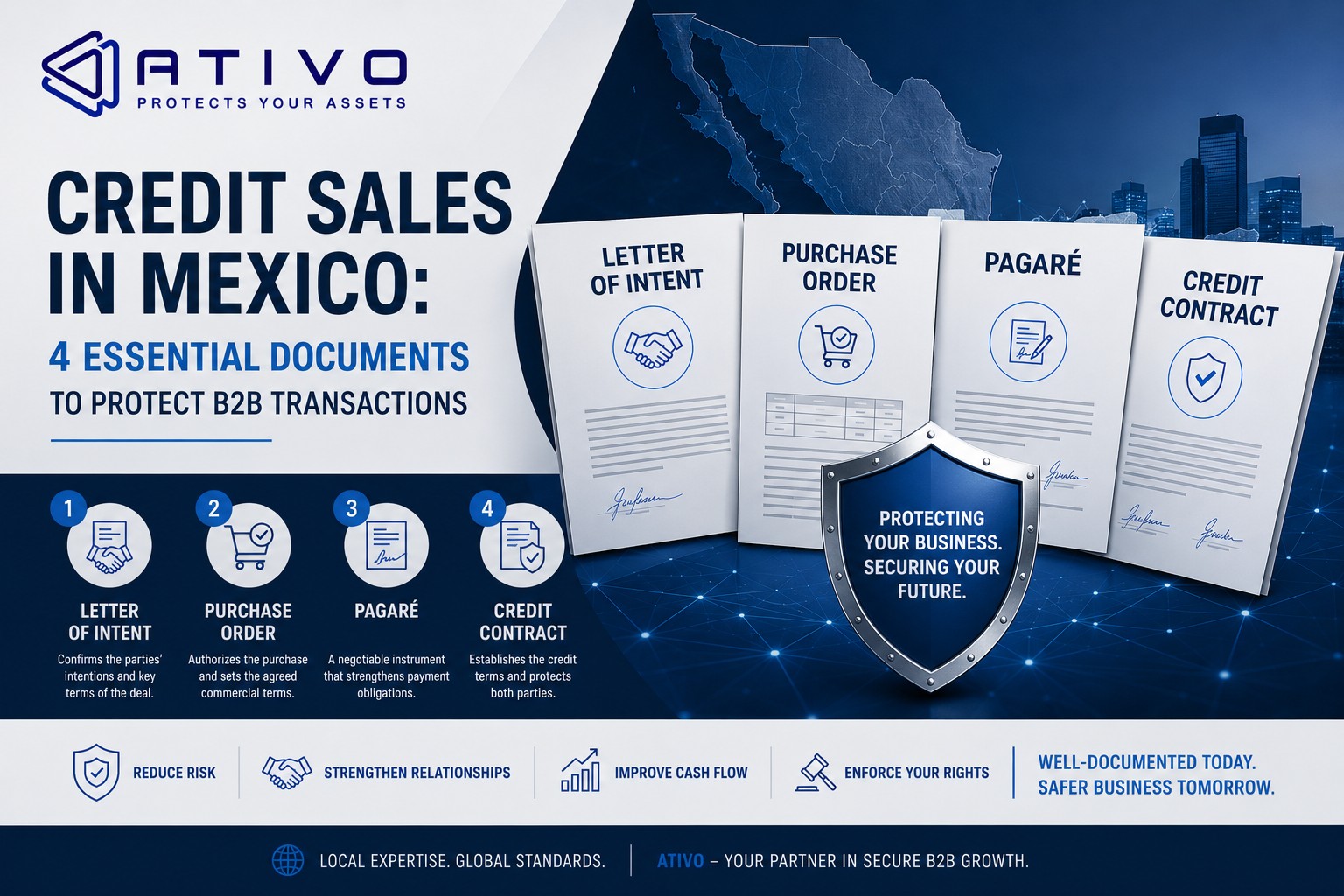
📄 In Mexico, credit sales between companies are the primary source of business financing — far exceeding bank credit in volume and frequency. But the lack of formal documentation in most B2B transactions is also the primary reason those credit sales become uncollectable. This article details the four essential documents that protect every credit sale in Mexico and explains exactly what legal protection each one provides when a debtor does not pay.

Are your credit sales in Mexico protected with the right documentation?

→ Get a free credit documentation assessment from ATIVO

Why Credit Sales in Mexico Require Formal Documentation

In the Mexican B2B market, the speed required to close transactions frequently works against the formality needed to protect them. A buyer who accepts a delivery, signs for a receipt, and commits verbally to payment in 30 days has created a commercial relationship — but not necessarily a legally enforceable one. When that buyer stops paying, the creditor's recovery options depend entirely on what was documented at the moment the credit sale in Mexico was made.

The difference between a documented and an undocumented credit sale in Mexico is not merely a matter of preference — it is the difference between having access to the juicio ejecutivo mercantil (which allows asset seizure from day one of proceedings) and being limited to extrajudicial negotiation with no judicial leverage. Under Article 1391 of the Código de Comercio, only certain instruments qualify as executable titles — and a verbal agreement or an unsigned invoice is not among them.

⚠️ The documentation gap in Mexican B2B credit: In practice, most B2B credit sales in Mexico are not formally documented — companies rely on invoices, verbal commitments, and email confirmations. These provide limited legal protection. A promissory note (pagaré) or credit contract signed at the point of sale provides the same transaction with the full force of Mexican commercial law behind it — at no additional cost, and without signaling distrust to the buyer.

As we explore in our guide on key strategies for bad debt recovery in Mexico, the quality of the documentation at the moment the credit is extended determines which recovery instruments remain available when the account goes overdue. The four documents below represent the complete formalization toolkit for any B2B credit sale in Mexico.


The 4 Essential Documents for Credit Sales in Mexico
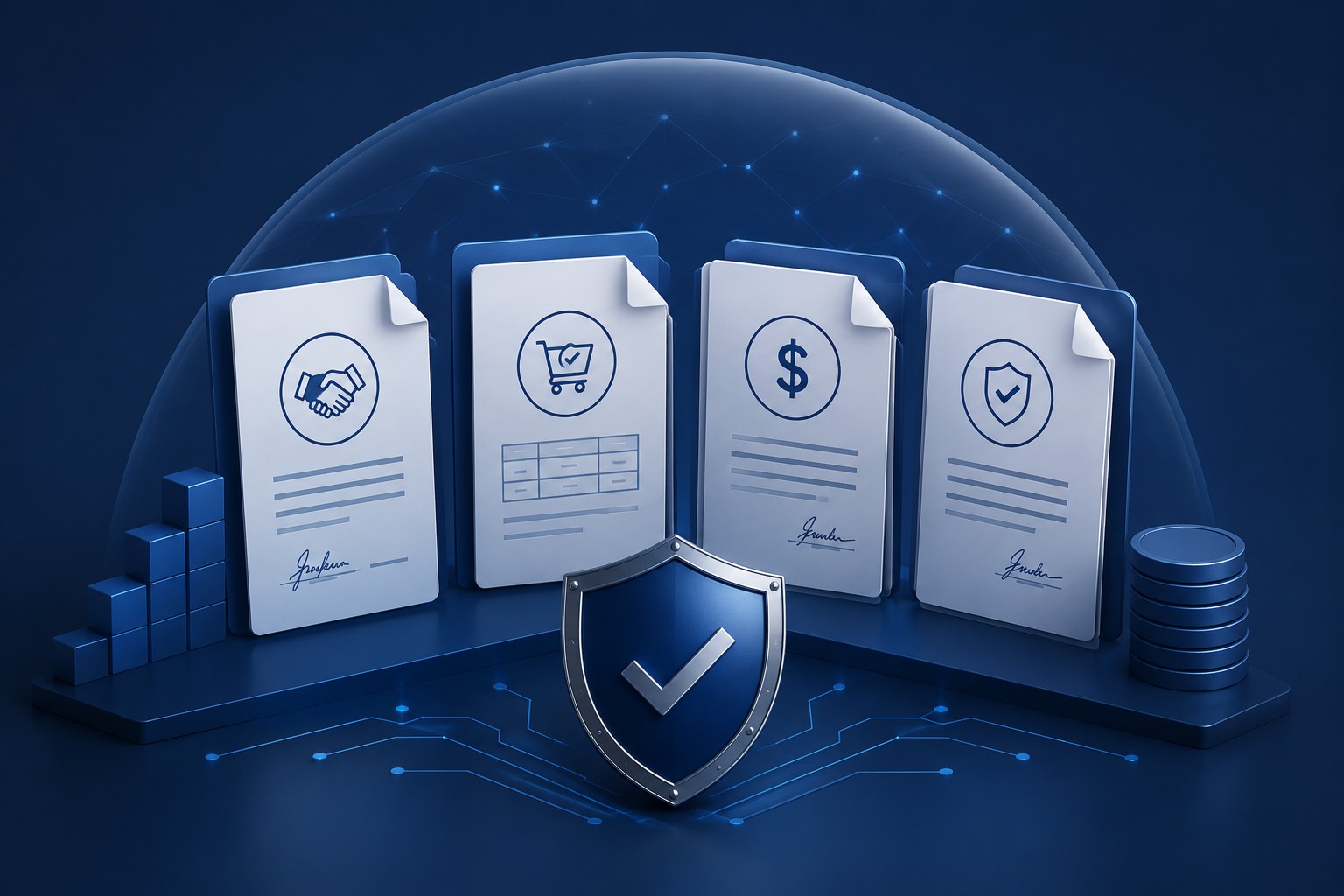
B2B credit documentation Mexico: the 4 essential documents for formalizing credit sales and protecting invoice collection — ATIVO
1
Letter of Intent (Carta de intención) A letter of intent records the buyer's expressed intention to purchase, tailored to the specific terms and conditions of the project or transaction. It is not yet a binding contract — it is a pre-contractual instrument that establishes the commercial framework and the parties' mutual understanding before the formal transaction documents are signed. In complex B2B transactions involving negotiation phases, it protects both parties during the negotiation period and establishes the conditions under which the purchase will proceed. While it does not create an executable title, it provides documentary evidence of the buyer's expressed commercial intent — valuable in extrajudicial negotiations and as supporting documentation in litigation.
2
Purchase Order (Orden de compra) A purchase order is a sequentially numbered commercial document that specifies the exact conditions of the goods or services being acquired: quantities, specifications, unit prices, delivery terms, and payment conditions. In Mexican B2B practice, a purchase order signed by the buyer constitutes written evidence of the transaction and the buyer's acceptance of the commercial terms — including payment terms. It is stronger than a verbal commitment and more specific than an invoice, because it captures the terms at the moment of agreement rather than at the moment of billing. A signed purchase order is an important element in extrajudicial collection — it demonstrates that the buyer accepted the credit terms before the invoice was issued.
3
Promissory Note (Pagaré) The pagaré is the most powerful instrument for protecting credit sales in Mexico. Under the General Law of Negotiable Instruments and Credit Transactions (LGTOC) and Article 1391 of the Código de Comercio, a pagaré is an executable title — meaning that a creditor holding a signed, valid pagaré can initiate juicio ejecutivo mercantil proceedings immediately upon default, requesting asset seizure (embargo preventivo) from the very first day of judicial proceedings, without requiring a separate trial on the merits of the debt. The prescription deadline for a pagaré is 3 years from its maturity date. It establishes the exact amount owed, the parties' identities, the maturity date, and the applicable interest rate — all in a single document with maximum judicial enforceability.
4
Credit Contract (Contrato de crédito) A credit contract — whether private or elevated to public instrument (escritura pública) — formally establishes all the rights and obligations arising from the credit sale: the amount, payment terms, applicable interest rates (ordinary and penalty), collection fees in the event of default, and the consequences of non-compliance. Under Mexican commercial law, a credit contract signed by both parties provides strong evidentiary value and — when combined with a formal acknowledgment of debt (convenio de reconocimiento de adeudo) — may qualify as an executable title. A credit contract is particularly important for high-value recurring transactions, where a single signed document governs an ongoing commercial credit relationship rather than a transaction-by-transaction approach.

Comparing the 4 Credit Sales Documents in Mexico: Legal Strength and Collection Use

Not all credit documentation provides the same level of legal protection. The table below compares the four instruments by their enforceability in Mexican commercial collection proceedings:

📝 Promissory note (Pagaré)
Judicial enforcement✅ Immediate
Asset seizure (day 1)✅ Yes
Prescription deadline3 years
Best forAll B2B credit sales
📋 Credit Contract
Judicial enforcement⚠️ With conditions
Asset seizure (day 1)⚠️ If public deed
Prescription deadline10 years
Best forRecurring high-value transactions
🛒 Purchase Order
Judicial enforcement⚠️ Supporting evidence
Asset seizure (day 1)❌ No
Prescription deadline10 years
Best forExtrajudicial leverage
✉️ Letter of Intent
Judicial enforcement❌ Pre-contractual
Asset seizure (day 1)❌ No
Prescription deadlineDepends on context
Best forComplex negotiation phases

The practical implication: for every B2B credit sale in Mexico, a pagaré signed at the moment of the transaction is the single most effective document the creditor can hold — not because it changes the commercial relationship, but because it transforms an invoice-based credit claim into an executable title with maximum judicial force. As we detail in our article on penalty interest and collection fees in B2B credit sales in Mexico, these charges are only enforceable when they have been documented in writing — making the credit contract or pagaré the vehicle through which they are established.

Are your current credit sales documents in Mexico giving you full legal protection?

→ Request a credit documentation review from ATIVO

How to Implement Formal Documentation for Credit Sales in Mexico: 5 Practical Steps

Moving from undocumented to properly documented credit sales in Mexico does not require a complete overhaul of existing commercial relationships — it requires integrating the right documents at the right moments in the transaction flow. These five steps define how to do it without disrupting commercial relationships or signaling distrust to buyers.

1
Start with new clients — not existing ones. The easiest implementation is with new buyers, before a commercial relationship and payment history exists. A credit application signed at the start of the relationship — including a penalty interest clause and collection fee provision — establishes documentation without any perception of distrust from an existing partner.
2
Integrate the pagaré into the delivery or invoicing process. For transactions where a pagaré is appropriate, the most effective moment to obtain the signature is at delivery — when the buyer's acceptance of the goods or services is fresh and the payment obligation is most recent. Framing the pagaré as a standard process (not a special requirement) is the most effective way to reduce friction.
3
Use the credit contract for high-value recurring relationships. For buyers with whom you have ongoing credit sales, a master credit contract that governs the entire relationship is more efficient than a transaction-by-transaction approach. Include penalty interest, collection fees, and explicit default consequences — all will be enforceable without re-negotiation on each invoice.
4
Never rely on a signed invoice alone. An invoice — even one signed for receipt by the buyer — is not an executable title under Mexican commercial law. It provides evidentiary value for extrajudicial negotiations and some judicial paths, but it does not allow the immediate asset seizure that a pagaré enables from day one of juicio ejecutivo mercantil proceedings.
5
Combine documentation with pre-credit KYC. A well-documented credit sale to the wrong buyer is still a risk. As we explore in our guide on KYC reports for B2B credit sales in Mexico, a pre-credit intelligence report provides the financial, legal, and commercial information needed to decide who to extend credit to and under what terms — before the pagaré is signed and before the invoice is issued.

Frequently Asked Questions — Credit Sales in Mexico: Documentation

What is the most important document for protecting a credit sale in Mexico?
The promissory note (pagaré) is the most powerful instrument for protecting credit sales in Mexico. Under Article 1391 of the Código de Comercio, a pagaré is an executable title that allows immediate judicial proceedings — including asset seizure from day one — without requiring a separate trial on the merits of the debt. No other credit document provides this level of immediate judicial enforceability. For B2B transactions, a pagaré signed at the point of delivery or invoicing transforms the credit relationship from an informal obligation into one with full judicial protection for the creditor.

Can a signed invoice protect a credit sale in Mexico?
A signed invoice provides evidentiary value in extrajudicial negotiations and some judicial proceedings — but it does not qualify as an executable title under Mexican commercial law. This means a creditor holding only a signed invoice cannot initiate juicio ejecutivo mercantil proceedings with immediate asset seizure; they must pursue the juicio ordinario mercantil, which has a higher evidentiary burden, a longer timeline, and no day-one asset seizure. For maximum protection of B2B credit sales in Mexico, a pagaré or credit contract should accompany every significant transaction.

What happens if a credit sale in Mexico has no written documentation?
Without written documentation, the creditor's recovery options are limited to extrajudicial negotiation — direct contact, demand letters, and payment agreements. There is no judicial leverage and no executable title. A debtor who knows the creditor has no documentation can negotiate from a position of structural advantage. The practical outcome is lower recovery rates, longer resolution timelines, and a higher probability of bad debt. For this reason, any existing undocumented overdue accounts should be prioritized for documentation at the earliest opportunity — even a retroactive payment agreement with a pagaré provides judicial protection going forward.

What is the prescription deadline for enforcing a promissory note (pagaré) in Mexico?
Under Mexican commercial law, the prescription deadline for a promissory note (pagaré) is 3 years from its maturity date. After this deadline passes, the right to initiate judicial collection through the juicio ejecutivo mercantil is permanently lost — regardless of the amount owed or the debtor's capacity to pay. A check has a prescription window of only 6 months from issuance; a commercial contract or formally acknowledged invoice typically 10 years. Prescription deadline tracking for every credit sale in Mexico should be a systematic process, not an afterthought.


Protect every credit sale in Mexico with the right documentation — before the invoice is overdue.

→ Get a free credit documentation review from ATIVO