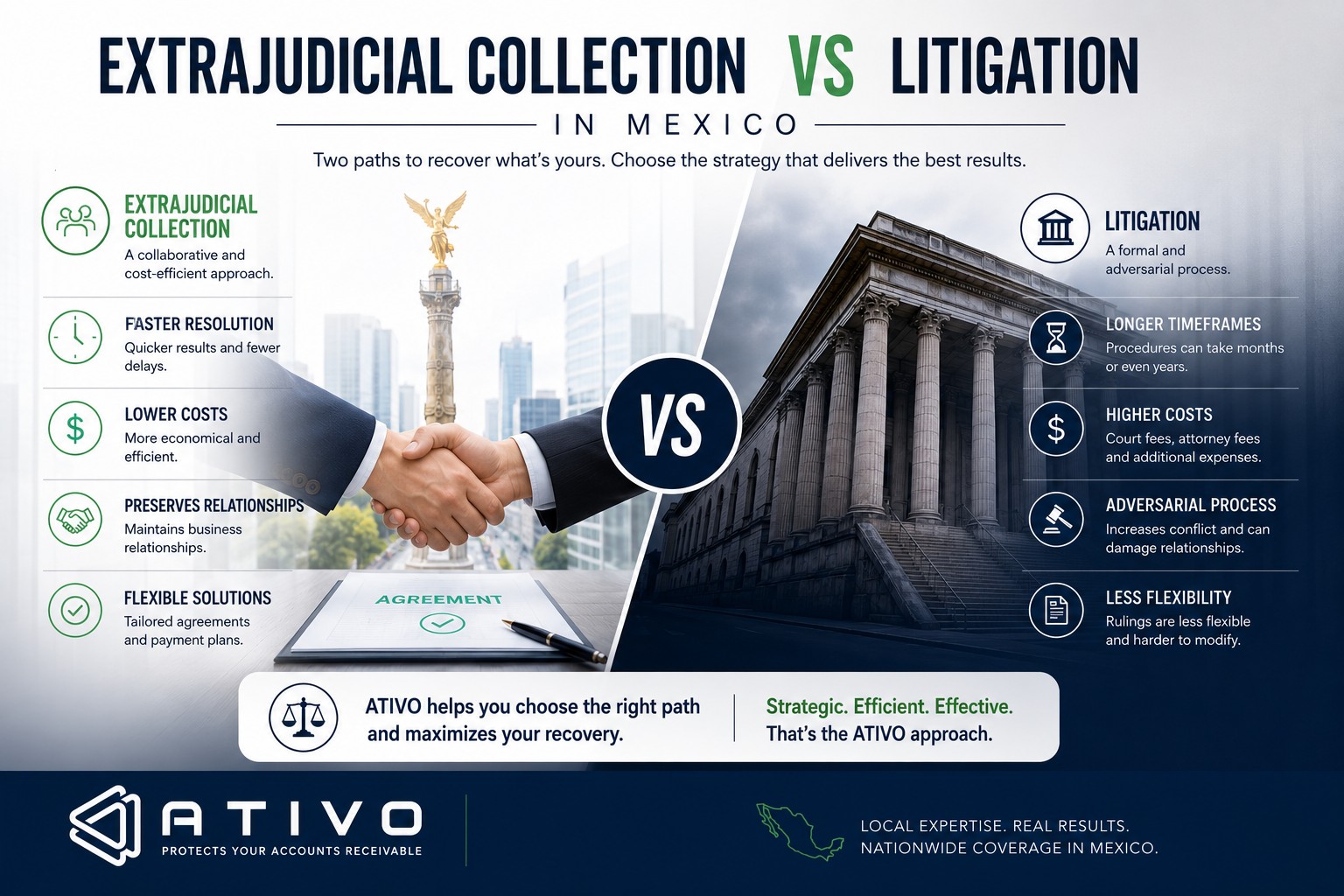

⚖️ When a Mexican client stops paying, every creditor faces the same decision: negotiate or litigate? The answer is rarely obvious — and choosing the wrong path at the wrong moment costs money, time, and sometimes the right to collect at all. Extrajudicial collection in Mexico resolves between 70% and 80% of B2B cases without a lawsuit. But when it doesn't, knowing exactly when and how to escalate to litigation is what separates a managed recovery from an unrecoverable loss.
Not sure whether to negotiate or litigate on your overdue account in Mexico?
→ Get a free case assessment from ATIVO — no upfront feesExtrajudicial Collection in Mexico vs. Litigation: The Fundamental Difference
Extrajudicial collection in Mexico — also called out-of-court collection — is the process of recovering a commercial debt through direct negotiation, formal demand letters, and binding payment agreements, without filing a lawsuit. It is faster, less expensive, relationship-preserving, and — when executed by a professional specialist — the first-choice path for any B2B receivable in the Mexican market.
Litigation — the judicial collection path — involves filing a formal claim before a Mexican commercial court. The two main instruments are the juicio ejecutivo mercantil (for creditors holding an executable title like a pagaré) and the juicio ordinario mercantil (for documented debts without an executable title). Both produce a judicial ruling — but a ruling is not the same as payment. Collection from a judgment depends entirely on the debtor's liquidity and the enforceability of the sentence.
- Resolves 70–80% of B2B cases without court
- Timeline: 30–90 days
- No upfront fees — success-fee model
- Preserves the commercial relationship
- Flexible payment agreements
- No prescription deadline risk during process
- Required when debtor is resistant or evading
- Timeline: 6–18+ months
- Legal fees + filing costs upfront
- Typically ends the commercial relationship
- Asset seizure available from day one (pagaré)
- Must initiate before prescription deadline
The critical point: extrajudicial and judicial collection are not competing strategies — they are sequential phases of the same recovery process. As we detail in our guide on alternatives for recovering overdue accounts receivable in Mexico, the best outcome is when a specialist manages both phases without the creditor having to change providers, lose case context, or restart the process.
Why Extrajudicial Collection in Mexico Is Always the Rational First Step
The structural advantage of extrajudicial collection in Mexico is not only speed or cost — it is leverage. A professional specialist makes the escalation path visible to the debtor from the first contact: the demand letter, the payment deadline, and the explicit consequence of non-compliance (judicial filing) are all part of the negotiation strategy. This visibility is what drives resolution without litigation.
Four reasons why extrajudicial collection should always precede litigation in Mexican B2B cases:
When Extrajudicial Collection in Mexico Is Not Enough: 4 Escalation Triggers
Professional extrajudicial collection in Mexico resolves the majority of cases — but not all of them. There are four specific scenarios where escalation to judicial proceedings is not optional: it is the only remaining path to recovery.

As we explore in our article on proven B2B debt recovery tips for the Mexican market, the most common failure point is the absence of a defined escalation threshold — companies keep extending informal deadlines until the prescription window has closed and the judicial option is no longer available.
Is your account in Mexico approaching an escalation threshold?
→ Talk to a specialist — understand your options before the window closesThe Judicial Path: How Commercial Litigation in Mexico Actually Works
When extrajudicial collection in Mexico has been exhausted, the judicial process follows a defined procedural sequence under Mexican commercial law. Understanding this sequence helps creditors set realistic expectations about timeline, cost, and outcome probability.
Total timeline from filing to enforcement: typically 6 to 18 months for a juicio ejecutivo mercantil; 12 to 36 months for a juicio ordinario mercantil in contested cases. The critical variable is documentation quality — creditors with well-structured executable titles consistently achieve faster and more complete recovery through the judicial path.
The Right Answer: Extrajudicial Collection in Mexico First, Judicial Escalation Ready
The question is not "negotiate or litigate" — it is "when does each phase begin, and who manages the transition?" The most effective B2B collection strategy in Mexico integrates both paths under one provider: extrajudicial collection in Mexico activated within 30–45 days of delinquency, with a defined escalation threshold and an in-house judicial team ready to file without delay if the extrajudicial phase does not produce resolution.
This integrated model eliminates the two most common failure points in corporate collection:
- The handoff gap: When a creditor uses one provider for extrajudicial collection and a separate law firm for litigation, the transition loses case context, resets timelines, and gives the debtor additional time to respond or transfer assets. An integrated provider eliminates this gap entirely.
- The informal extension trap: When internal teams manage collection and keep extending informal deadlines — "give the client one more chance" — the prescription deadline narrows without any formal process being documented. A professional specialist sets clear thresholds and enforces them.
As we detail in our guide on key strategies for bad debt recovery in Mexico, the companies that consistently recover the highest proportion of overdue receivables are those that treat collection as a structured process with defined phases — not a series of ad hoc decisions made under pressure.
Frequently Asked Questions — Extrajudicial Collection Mexico
What is extrajudicial collection in Mexico and how does it differ from litigation?
Extrajudicial collection in Mexico is the process of recovering a commercial debt through direct negotiation, formal demand letters, and payment agreements — without filing a lawsuit. It is faster (30–90 days), less expensive (success-fee model, no upfront cost), and relationship-preserving. Litigation — the judicial path — involves filing a commercial claim before a Mexican court, produces a ruling in 6–18 months, requires upfront legal costs, and typically ends the commercial relationship. Both paths can and should be managed by the same provider for seamless escalation.
When should a company in Mexico escalate from extrajudicial collection to litigation?
Escalation is appropriate when: (1) the debtor has not responded to structured extrajudicial contact after 60–90 days; (2) the debtor has defaulted on a signed payment agreement; (3) there is credible evidence of asset transfer; or (4) the prescription deadline for the available title is within 180 days. Once the prescription deadline expires — 3 years for a pagaré, 6 months for a check — the judicial option is permanently lost regardless of the amount owed or the debtor's capacity to pay.
Can a debt in Mexico be recovered without going to court?
Yes — and for most B2B cases, it should be. Out-of-court debt collection Mexico resolves between 70% and 80% of corporate accounts without any judicial proceeding. Professional extrajudicial collection through demand letters, direct negotiation, and formalized payment agreements (ideally backed by a pagaré) produces faster and more cost-effective recovery than litigation in the majority of cases. Court proceedings are reserved for resistant debtors, asset transfer scenarios, or cases where the prescription deadline is imminent.
What is the prescription deadline for commercial debt collection in Mexico?
Under the Mexican Commercial Code (Código de Comercio), the prescription deadline — after which the right to litigate is permanently lost — is: 3 years for a promissory note (pagaré) from its maturity date; 6 months for a check from the date of issuance; and typically 10 years for a commercial invoice or contract-based obligation from when the obligation became enforceable. These deadlines apply regardless of whether any extrajudicial collection efforts have been made, and cannot be extended after expiry.
Negotiate or litigate? Make the right decision with the right specialist — no upfront fees.
→ Get a free case assessment from ATIVO