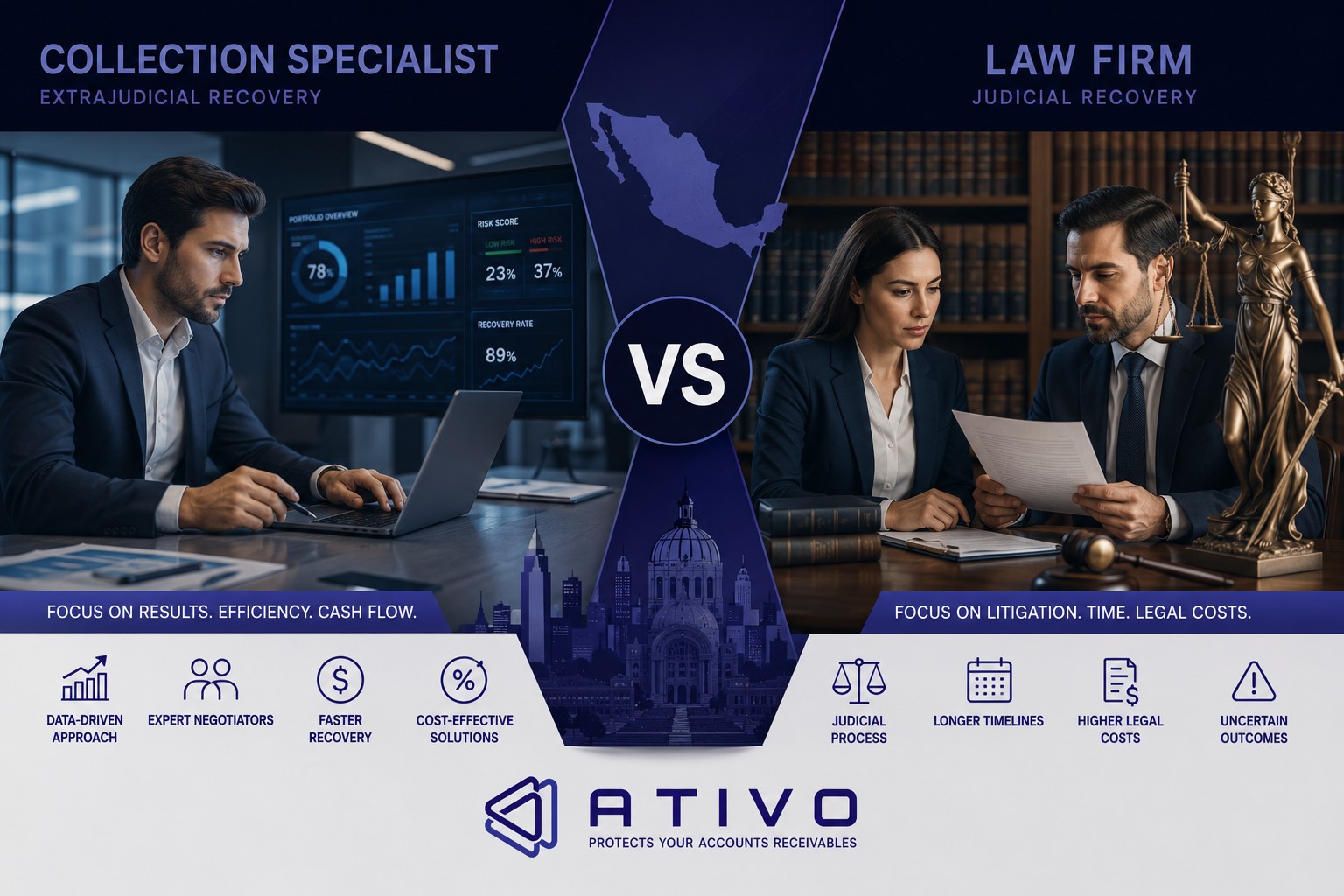

⚖️ When a Mexican client stops paying, most international companies face the same question: hire a collection specialist in Mexico or send the file to a law firm? The two options are not interchangeable — they operate at different stages of the recovery cycle, carry different cost structures, and produce different results depending on debt age, available documentation, and debtor behavior. Choosing the wrong path at the wrong moment means paying legal retainers for a case a specialist would have resolved in 45 days — or missing a prescription deadline because no formal action was taken in time.
Not sure which path fits your overdue account in Mexico?
→ Get a free case assessment from ATIVOCollection Specialist in Mexico vs. Law Firm: The Critical Distinction
A collection specialist in Mexico is designed to recover cash — through structured extrajudicial processes, direct negotiation, and binding payment agreements — on a success-fee basis with no upfront cost. A law firm is designed to litigate: to file claims, argue before a judge, and obtain judicial rulings — with retainers, filing fees, and timelines measured in months, not weeks.
The distinction matters because in most B2B cases, what the creditor needs is payment, not a court ruling. A ruling without an enforceable debtor — one with hidden assets, no liquidity, or clear bad faith — produces paperwork, not cash. A collection agency in Mexico focused on recovery closes the gap between what is owed and what is collected, faster and at lower net cost, for the majority of commercial accounts.
The 60–90 Day Window: Why Timing Defines the Outcome in Debt Recovery Mexico
In debt recovery Mexico, the most reliable predictor of success is not the amount owed or the quality of documentation — it is how early the specialist is engaged. Recovery rates at 30–45 days overdue are substantially higher than at 90+ days, because the debtor's liquidity, willingness to negotiate, and asset visibility all deteriorate with time.
Under the Código de Comercio, the right to litigate a promissory note (pagaré) expires in 3 years from the maturity date. A check: 6 months. A commercial invoice: typically 10 years. Once the deadline passes, no court will accept the claim — regardless of how clear or documented the debt is. Engaging a collection specialist in Mexico early is not just about speed: it is about preserving your legal options before they expire permanently.
As we explore in our article on managing debts in Mexico before they silently affect your cash flow, many international companies discover a growing overdue portfolio only when it has reached a stage where extrajudicial leverage is reduced and judicial options are already narrowing. The best intervention is always the earliest one.
How a Collection Specialist in Mexico Recovers Your Invoice: 5 Steps
A professional collection specialist in Mexico does not simply call the debtor and ask for payment. The extrajudicial process is structured, legally grounded, and designed to maximize recovery probability while preserving the judicial option as a backstop if the account escalates.

As we detail in our guide on alternatives for recovering overdue accounts receivable in Mexico, the choice between extrajudicial, juicio ejecutivo mercantil, and juicio ordinario mercantil depends on debt profile, documentation, and debtor behavior. A specialist who knows which instrument to apply, and when, recovers more at lower total cost.
Is a prescription deadline approaching on one of your Mexico accounts?
→ Act now — the window closes permanentlyWhen Does It Make Sense to Go Directly to a Law Firm in Mexico?
There are specific scenarios where engaging legal counsel directly — without a prior extrajudicial phase — is the rational decision. A credible collection specialist in Mexico will tell you this themselves: the goal is recovery, not any particular method.
Why Extrajudicial Collection Mexico First Is the Rational Default
Between 70% and 80% of B2B commercial accounts in Mexico are resolved through professional extrajudicial collection — without any judicial filing. This reflects the structural incentives governing debtor behavior in the Mexican market:
- Mexican debtors respond to professional, documented collection pressure because a structured process signals that judicial escalation is the next step — not an empty threat.
- The debtor's credit reputation and supplier relationships are directly at risk from non-payment, and a skilled specialist makes that cost explicit in the negotiation.
- A signed payment agreement (convenio de pago) backed by a pagaré converts a disputed invoice into an executable title — giving the creditor immediate legal initiative if the debtor defaults again.
- No upfront cost means the creditor's only risk is time — not a legal invoice disconnected from recovery outcomes.
As we explore in our article on proven B2B debt recovery tips for the Mexican market, the companies that consistently achieve the highest recovery rates are those that engage a specialist early and maintain a clear escalation structure — not those who rush to litigation or extend informal deadlines indefinitely.
How to Evaluate a Collection Specialist in Mexico Before Hiring
Not every provider calling itself a collection agency in Mexico delivers the same depth of capability. International creditors should evaluate candidates against five non-negotiable requirements before committing a case:
Frequently Asked Questions — Collection Specialist in Mexico
What is the difference between a collection specialist in Mexico and a law firm for recovering overdue invoices?
A collection specialist in Mexico focuses on recovering cash through extrajudicial negotiation, demand letters, and payment agreements — on a success-fee basis with no upfront cost. A law firm focuses on obtaining a judicial ruling through court proceedings, which takes longer, requires a retainer, and may or may not result in actual payment. For most B2B cases under 180 days overdue, a specialist delivers faster results at lower total cost. The ideal provider combines both capabilities under one structure, eliminating the need to change providers if judicial escalation becomes necessary.
When should a company hire a collection specialist in Mexico instead of going directly to a law firm?
In most cases, a collection specialist in Mexico should be the first engagement — particularly within the first 60 to 90 days of delinquency. The extrajudicial route resolves between 70% and 80% of B2B accounts without litigation, preserves the commercial relationship, and operates on a success-fee model. A law firm should be engaged directly when a prescription deadline is imminent, the debtor is actively transferring assets, or legal complexity requires counsel from the outset. Specialists who offer in-house judicial escalation make the sequence seamless without requiring a provider change.
How long does extrajudicial debt recovery Mexico take compared to litigation?
Professional extrajudicial collection Mexico typically resolves an account in 30 to 90 days when the debtor is locatable and responsive. The judicial path — juicio ejecutivo mercantil or juicio ordinario mercantil — takes 6 to 18 months from filing to judgment, with additional time if asset seizure enforcement is required. Early extrajudicial engagement significantly improves outcomes and preserves the judicial path as a backstop — available until the prescription deadline expires under the Código de Comercio.
Does hiring a collection agency in Mexico affect the relationship with the Mexican client?
Professional extrajudicial collection in Mexico is designed to be firm but non-adversarial. A skilled specialist negotiates payment agreements that allow the debtor to comply while giving the creditor an enforceable commitment — preserving the possibility of future business. Litigation typically ends the commercial relationship. Companies that maintain structured collection processes are more attractive trading partners: their credit terms are credible because their enforcement is real.
Manage your overdue accounts in Mexico before time runs out.
→ Get a free collection assessment from ATIVO